Insider Trading Investigation Dashboard
The Experiment Clause: Meta, the Research Credit, and the Trump Money Map
Meta tells investors its A.I. push is a tremendous success. Its tax return, according to the New York Times, tells the I.R.S. that the same data centers are an experiment that could fail, which is what the research credit requires. This page pins the reporting to Meta's SEC filings, measures how the credit and uncertain-tax-position reserves look across every SEC filer, and checks the question the Old Goat cares about most, presenting evidence without alleging any crime and leaving the conclusions to the reader: whether the money flowing to Trump-controlled committees lines up with who claims aggressive positions.
Last built 2026-09-30 · Sources: SEC XBRL frames API, FEC OpenFEC API, published court opinions, IRS Chief Counsel memo 20170501F. Scripts: fec_trump_employer_pull.py · rd_credit_scan.py · rd_credit_case_donors.py · ceo_comp_credit_scan.py · ceo_form4_history.py · ceo_form4_summary.py · build_ceo_incentive_metrics.py
1 · What was reported
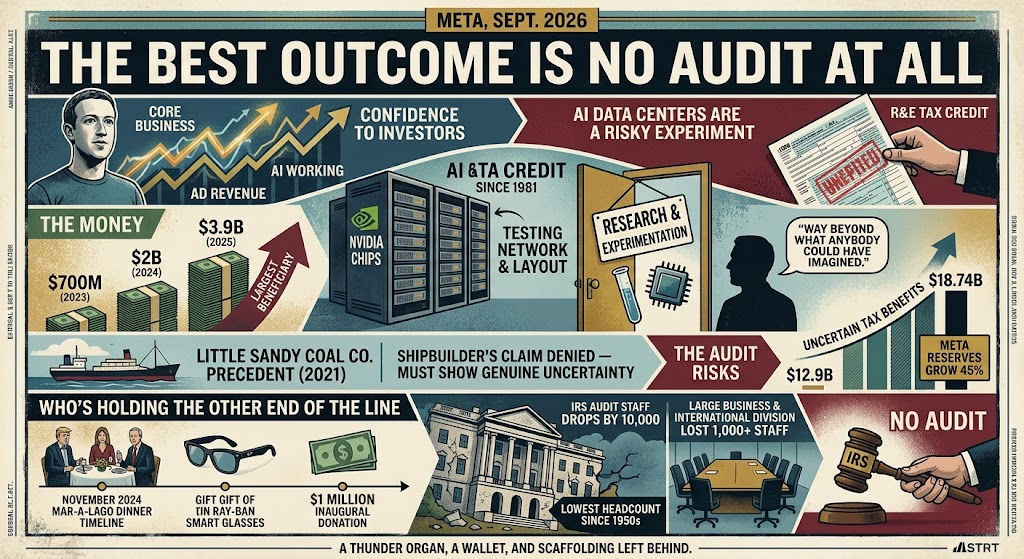
REPORTEDThe New York Times (Sept. 29, 2026), citing four anonymous people with knowledge of Meta's operations plus securities filings, reports that since 2024 Meta has classified its A.I. data centers as "pilot models" for the research and experimentation credit and claims the cost of Nvidia chips and similar equipment under it; that some Meta finance staff questioned whether it would survive I.R.S. review; and that outside tax specialists called the approach aggressive. Meta says it uses incentives Congress established to encourage domestic R&D investment.
REPORTEDThe same article says Meta consulted outside counsel, that Meta's auditor EY signed off and has since pitched other companies on the same approach, and that Apple, Amazon, Alphabet and Microsoft claim research credits over $1B a year without flagging the credit as a risk. The lawyers and firms named in that reporting are named there as advisers consulted, and nothing on this page implies wrongdoing by any of them.
2 · What Meta's own filings show
DOCUMENTEDEvery number below comes from Meta's SEC XBRL data (CIK 1326801) and matches the reporting.
| Item | Value | Filing (accession) |
|---|---|---|
| Unrecognized tax benefits, Jun 30 2024 | $12.91B | 10-Q 0001326801-24-000069 |
| Unrecognized tax benefits, Dec 31 2025 | $16.45B | 10-K 0001628280-26-003942 |
| Unrecognized tax benefits, Jun 30 2026 | $18.74B (+45.2% in two years) | 10-Q 0001628280-26-050705 |
| Research credit, FY2025 | $3.91B | 10-K 0001628280-26-003942 |
| Research credit, FY2024 / FY2023 (implied) | ≈$2.05B / ≈$711M | Rate reconciliation 2.9% / 1.5% × pretax income (10-K) |
INFERENCEThe FY2024 and FY2023 credit amounts are not a dedicated dollar line in the XBRL; they are computed here from the disclosed rate-reconciliation percentages, and land within rounding of the reported $2.0B and $0.7B. The dollar step from $0.7B to $3.9B is the "data center effect" the Times describes; the filings do not say which portion comes from data-center chips.
DOCUMENTEDMeta's separate Tax Court dispute over crediting Mark Zuckerberg's stock options as research wages (about $355M of $618M claimed for 2012–2013) is on the public record via Bloomberg Tax. The Times piece dates the claim to 2013; the court reporting covers both 2012 and 2013.
3 · The money: Meta and the Trump projects
REPORTEDMeta gave $1 million to Trump's inaugural fund (Dec. 2024); agreed in Jan. 2025 to pay $25 million to settle Trump's account-suspension lawsuit ($22M reported as going to his presidential library, $3M to legal fees); and appears on the White House's ballroom donor list (37 donors, no amounts). None of these is an FEC-reported campaign contribution, so none appears in the FEC scan below. Amazon, Apple, Alphabet/Google, Microsoft and Comcast are also on the ballroom list.
DOCUMENTEDEmployees who list Meta as employer gave $47,350 in itemized gifts to the eight Trump-controlled committees scanned. Employee giving is not corporate giving; it is shown because it is what the FEC data can show.
INFERENCENothing in the public record ties any of these payments to any I.R.S. treatment of Meta's tax positions. The record shows the payments and the positions exist at the same time, and that is all it shows.
4 · Do donor-linked companies stand out? A baseline test
The baseline rule for this site: never trust "the donors look different" without comparing them to everyone else. Universe: every SEC registrant reporting at least $100M of FY2025 R&D expense (628 companies). "Donor-linked" means employees gave $50K+ in itemized gifts to the Trump-controlled committees below (2020–2026 cycles), or the company is on the press-documented list in section 3 (27 companies). Two-sided permutation test on the difference of medians, 20,000 shuffles.
| Metric (FY2025) | Donor-linked median | All others median | p-value |
|---|---|---|---|
| Research credit ÷ R&D expense | 4.8% (n=16) | 3.2% (n=335) | 0.034 |
| Unrecognized tax benefits ÷ total assets | 0.98% (n=21) | 0.87% (n=473) | 0.802 |
| UTB ÷ R&D expense | 30.2% (n=21) | 10.4% (n=473) | 0.001 |
| UTB growth, 2023 → 2025 | 0.3% (n=20) | 18.9% (n=416) | 0.142 |
| UTB settled with tax authorities ÷ prior UTB (proxy for "resolved") | 2.7% (n=17) | 1.4% (n=181) | 0.245 |
| UTB lapsed via statute of limitations ÷ prior UTB | 1.2% (n=15) | 4.6% (n=225) | 0.180 |
DOCUMENTEDResult: donor-linked companies claim a higher research credit relative to R&D (about 4.8% vs 3.2%, p≈0.03) but show no difference on reserves scaled by company size (p≈0.80), on reserve growth, or on how much reserve is released through settlements or statute lapses. The donor-linked group also claimed $11.5B of the $25.8B research credit reported across all filers (45%), but that mostly says the largest R&D spenders are also the largest political givers.
INFERENCERead this as weak and unproven. The donor-linked group is 16 to 21 companies, concentrated in big tech, defense and industrials (industries that do more qualifying research), and a p-value near 0.03 across six tests is not strong. The "UTB ÷ R&D" row is misleading and shown only for transparency: energy, casino and finance donors carry large reserves against small R&D. Nothing here measures audit outcomes.
Excluded by sanity gate (research credit > 50% of same-year R&D, likely an XBRL tagging or scaling error): HOWMET AEROSPACE INC., KAISER ALUMINUM CORPORATION, Tredegar Corporation, NU SKIN ENTERPRISES, INC., FLOWERS FOODS, INC, Mistras Group, Inc., Galera Therapeutics, Inc., Science Applications International Corporation, and 7 others. FEC data gap: MAGA Inc. and the 2026 cycle are only partly populated by the FEC at this date.
5 · Largest research-credit claimants, FY2025
| Company | Credit | R&D expense | UTB reserve | Employee giving to Trump committees | Donor-linked |
|---|---|---|---|---|---|
| Meta Platforms, Inc. | $3,912M | $57,372M | $16.45B | $47,350 | yes press-documented |
| AMAZON.COM, INC. | $2,403M | — | $6.60B | — | no press-documented |
| Alphabet Inc. | $2,088M | $61,087M | $11.50B | $128,508 | yes press-documented |
| Apple Inc. | $1,049M | $34,550M | — | $199,321 | yes press-documented |
| INTEL CORPORATION | $977M | $13,774M | $1.38B | $157,092 | yes |
| ORACLE CORP | $621M | $10,272M | — | $379,179 | yes |
| THE BOEING COMPANY | $559M | $3,615M | $1.02B | $711,845 | yes |
| GENERAL MOTORS COMPANY | $478M | — | $0.58B | $185,434 | yes |
| Baidu, Inc. | $390M | $2,922M | — | — | no |
| Salesforce, Inc. | $368M | $5,993M | $2.64B | $14,908 | no |
| GENERAL ELECTRIC COMPANY | $354M | $1,580M | $3.06B | — | no |
| Tesla, Inc. | $352M | $6,411M | $1.75B | $49,963 | no |
| Ford Motor Co | $341M | $9,400M | $2.84B | $110,515 | yes |
| WALMART INC. | $323M | — | $2.44B | $746,992 | yes |
| Amgen Inc. | $272M | — | $4.37B | — | no |
SEC XBRL frames (IncomeTaxReconciliationTaxCreditsResearch, ResearchAndDevelopmentExpense, UnrecognizedTaxBenefits). Fiscal-year filers can land in the neighboring calendar year. Full universe: data/rd_credit_universe.csv; every donor-name match: data/rd_credit_donor_link.csv.
6 · Did CEO pay rise alongside the credit?
The Old Goat asked whether chief-executive pay and equity moved with the tax credit. Source: the pay-versus-performance tables every proxy statement must now file in SEC XBRL (Summary Compensation Table total, and "compensation actually paid," which swings with the value of stock awards).
DOCUMENTEDMeta: CEO summary-table pay was $27M (2021), $24M (2023), $27M (2024) and $25M (2025), essentially flat, while the research credit went from about $0.7B to $3.9B. On the filings, the credit did not travel with the CEO's reported pay. The dataset does not break out components, and it does not capture the value of shares Mark Zuckerberg already owns.
| Company (largest FY2025 credits) | Research credit 2023 → 2025 | CEO total pay 2023 → 2025 | Donor-linked |
|---|---|---|---|
| Meta Platforms, Inc. | $711M → $3,912M (+450%) | $24M → $25M (+3%) | yes |
| Alphabet Inc. | $1,575M → $2,088M (+33%) | $9M → $11M (+24%) | yes |
| GENERAL MOTORS COMPANY | — → $478M (—) | $28M → $30M (+7%) | yes |
| Salesforce, Inc. | $312M → $368M (+18%) | — → $49M (—) | no |
| WALMART INC. | — → $323M (—) | $27M → $29M (+8%) | yes |
| Amgen Inc. | — → $272M (—) | $23M → $25M (+9%) | no |
| DOORDASH, INC. | $44M → $135M (+207%) | $0M → $0M (+37%) | no |
| REGENERON PHARMACEUTICALS, INC. | — → $133M (—) | $8M → $7M (-11%) | no |
| Airbnb, Inc. | — → $121M (—) | $0M → $0M (-18%) | no |
| Roblox Corporation | $44M → $113M (+157%) | $2M → $25M (+1050%) | no |
DOCUMENTEDAcross 1,298 companies with CEO pay data, 95 also report a research credit in both 2023 and 2025 with at least $10M of R&D. For that group, growth in CEO total pay and growth in the credit are essentially unrelated (rank correlation +0.06, p=0.54; +0.03 after removing R&D growth). Using equity-sensitive "compensation actually paid" (71 companies) gives -0.10 (p=0.39).
INFERENCENo link between CEO pay and the credit shows up in this data. The sample is small because few companies tag a dollar credit in both years, pay disclosures cover the top executive only, and stock a founder already owns never appears as pay. Absence here is not evidence of absence; it means the question needs Form 4 grant and sale histories and proxy award tables, which are the next pull.
Scripts: ceo_comp_credit_scan.py (SEC XBRL ecd:PeoTotalCompAmt, ecd:PeoActuallyPaidCompAmt). Frames choose one CEO per company-year, so a year with a CEO change can be off. Full table: data/ceo_comp_credit_scan.csv.
7 · When does a CEO benefit from the credit, and how does it reach the stock?
INFERENCEThe credit is a tax reduction, so the first beneficiary is reported profit. The channel from there to an executive runs through four steps. The Old Goat has not audited each company's pay plan; where a plan pays on earnings, operating income or tax rate, the steps apply.
- Earnings. A lower tax bill lifts net income with no new revenue. DOCUMENTEDMeta's FY2025 credit of $3.91B equals 6.5% of its $60.5B net income, about $1.52 per diluted share. From 2023 to 2025 net income grew 55%; take the credit out of both years and it grew 47%. The credit supplied roughly 7 percentage points of that growth.
- Valuation. Markets pay a multiple of earnings. INFERENCEAt the stock's trailing P/E of 33 (about $777 recent sale price over FY2025 diluted EPS of $23.49), $1.52 of extra earnings per share would be worth about $50 per share, or 6.5% of the price and roughly $129B of market value. That is an arithmetic ceiling, not a claim about what the market did: it assumes the credit recurs, survives I.R.S. review, and is not already priced in.
- Who is paid on it. A CEO benefits three ways: pay or vesting tied to earnings-based goals; shares the CEO owns or receives (Meta's Form 4s show sales through entities at prices of $335 to $681); and buybacks, which shrink the share count on top of higher earnings (Meta's diluted shares fell from 2.629B to 2.574B). DOCUMENTEDMeta's CEO summary pay was flat over the same years, so for Meta the route is ownership, not pay.
- The timing asymmetry. INFERENCEOnly the portion of a tax position the company believes will hold up is booked as a benefit; the rest goes into the reserve (Meta's total reserve was $18.74B on Jun 30 2026, covering all its uncertain positions, not only the research credit). If the I.R.S. later wins, the cost arrives as tax, interest and penalties in a future year, on whoever holds the shares then. A holder who sold earlier, for example under a 10b5-1 plan, is gone by then. That is a description of how the incentive is structured, not evidence that anyone designed it so.
REPORTEDThe Times reports that Meta's own finance staff questioned whether the approach would hold, and that its tax reserve rose as a result. The reserve is the company's own estimate of how much of the benefit is at risk.
8 · The CEOs' Form 4 histories
DOCUMENTEDThe Old Goat pulled every Form 4 filed since 2021 for the chief executives of twelve of the largest research-credit claimants straight from SEC EDGAR (each CEO's personal reporting-owner CIK, raw XML, every transaction kept with its accession link). Open-market sales by year, code S:
| Company / CEO | FY2025 credit | Sales 2023 | Sales 2024 | Sales 2025 | 2025 sales under 10b5-1 plan | Coverage |
|---|---|---|---|---|---|---|
| Meta Platforms Zuckerberg Mark | $3,912M | $428M | $2,450M | $945M | 100% | 10,487 txns, 2021–2026 |
| Alphabet Pichai Sundar | $2,088M | $6M | $80M | $127M | 97% | 641 txns, 2021–2026 |
| General Motors Barra Mary T | $478M | $0 | $96M | $106M | 100% | 120 txns, 2021–2026 |
| Apple Cook Timothy D | $1,049M | $51M | $84M | $58M | 100% | 70 txns, 2021–2026 |
| Salesforce Benioff Marc | $368M | $662M | $587M | $49M | 100% | 4,602 txns, 2021–2026 |
| Walmart McMillon C Douglas | $323M | $15M | $25M | $28M | 83% | 84 txns, 2021–2026 |
| Amazon Jassy Andrew R | $2,403M | $11M | $33M | $17M | 100% | 169 txns, 2021–2026 |
| Boeing Ortberg Robert Kelly | — | $0 | $0 | $0 | — | 10 txns, 2024–2026 |
| Ford Farley Jr James D | $341M | $1M | $0 | $0 | — | 83 txns, 2021–2026 |
| General Electric Culp H Lawrence Jr | $354M | $0 | $0 | $0 | — | 16 txns, 2022–2026 |
| Lockheed Martin Taiclet James D Jr | $187M | $0 | $0 | $0 | — | 38 txns, 2021–2026 |
| Tesla Musk Elon | $352M | $0 | $0 | $0 | — | 1,335 txns, 2021–2026 |
DOCUMENTEDWhat the filings show about Meta: every reported Zuckerberg sale is booked as indirect ownership (held through entities, not his personal account), the 10b5-1 checkbox is ticked on all of them from 2023 on, none was reported in 2022, and the average reported sale price climbed from $335 (2023) to $495 (2024) to $681 (2025) while the credit grew from about $0.7B to $3.9B. Form 4 gifts of stock (code G) are reported separately and are not sales.
INFERENCEThe 10b5-1 column for years before 2023 reads 0% only because the checkbox did not exist on Form 4 until 2023; it does not mean no plans existed. A price that rose while the credit rose is a coincidence of timing until something ties them, and most of a megacap's price move comes from revenue and A.I. expectations. Tesla's CEO sales sit in 2021–2022, before the 2023–2025 window this page examines; the Tesla filings also report a 423,743,904-share grant (code A) on Nov. 6, 2025; a grant is not a sale, and it is kept out of the sales totals.
Files: data/ceo_form4_history.csv (every transaction) and data/ceo_form4_summary.json. Three Tesla rows tripped the value sanity gate (over $5B: the 2025 award and the 2026 option exercise plus matching tax withholding) and were kept in the CSV but left out of totals. CEOs at Intel and Oracle are excluded because the chief executive changed during the window.
9 · What the CEOs' pay plans actually measure
DOCUMENTEDThe Old Goat read the annual-bonus and long-term incentive sections of each of the twelve CEOs' latest proxy statements (DEF 14A, linked in the last column) to see which goals pay them. The question: could a tax credit move any of them?
| Company / CEO | Annual plan | Long-term plan | Moves with a lower tax bill (direct) | Moves with the share price (indirect) | Source |
|---|---|---|---|---|---|
| Meta Platforms Mark Zuckerberg | Not a participant in the Bonus Plan | No equity awards in 2025; the committee cited his existing ownership as sufficient alignment | none | ownership only | DEF 14A 2026-04-16 |
| Amazon Andy Jassy | No named executive officer received an annual incentive or cash bonus in 2025 | Time-vesting RSUs; no equity award to Jassy since 2021; no reliance on non-GAAP or adjusted measures in equity awards | none | ownership only | DEF 14A 2026-04-09 |
| Alphabet Sundar Pichai | Not identified in the sections read | Triennial grants of time-based GSUs plus PSUs on relative TSR vs the S&P 100; the 2022 award paid the maximum (3-year TSR 203.65%, 92.86th percentile); the March 2026 award puts a larger share in performance units | none | relative TSR | DEF 14A 2026-04-24 |
| Apple Tim Cook | Cash Incentive Plan: net sales and operating income, equally weighted (GAAP); 2025 paid at maximum | Performance RSUs on relative TSR vs the S&P 500 (0-200% of target; capped at 100% if absolute TSR is negative) | none | relative TSR | DEF 14A 2026-01-08 |
| General Motors Mary Barra | Annual plan: EBIT-adjusted 35%, adjusted automotive free cash flow 25%, strategic pillars 40% | 2025-2027 PSUs: relative TSR 40%, relative operating cash flow as a percentage of revenue 30%, relative EBIT-adjusted margin 30% | free cash flow, operating cash flow | relative TSR | DEF 14A 2026-04-20 |
| Tesla Elon Musk | None described | 2025 CEO Performance Award: up to 12% of the adjusted share count, earned through market-cap milestones (up to $8.5 trillion) paired with operational milestones (Adjusted EBITDA targets, 1 million Robotaxis, 1 million AI Bots) | none | market capitalization | DEF 14A 2025-09-17 |
| Ford Jim Farley | Annual Performance Bonus Plan: EBIT margin plus a quality metric (repairs per 1,000) | PSUs: relative TSR vs automaker peers is the sole metric | none | relative TSR | DEF 14A 2026-03-27 |
| Salesforce Marc Benioff | Program-wide bonus funded by subscription & support revenue and non-GAAP operating income, with a strategic modifier | FY2027 award of $48 million target value, 100% performance-based: subscription & support revenue growth, non-GAAP operating margin, relative TSR (with an absolute TSR cap) | none | relative TSR | DEF 14A 2026-04-16 |
| General Electric (GE Aerospace) Larry Culp | AEIP: revenue growth 20%, operating profit 40%, free cash flow 40% | PSUs: adjusted earnings per share 50% and free cash flow 50%, modified +/-20% by relative TSR vs the S&P 500 Industrials; capped at 175% | adjusted EPS, free cash flow | relative TSR | DEF 14A 2026-03-12 |
| Lockheed Martin Jim Taiclet | Annual incentive plan: Sales, Segment Operating Profit and Free Cash Flow | PSUs and LTIP: relative TSR 50%, ROIC 25%, free cash flow 25%; ROIC is net earnings plus after-tax interest over average invested capital, and the committee neutralized a prior-year uncertain-tax-position effect in the 2023-2025 calculation | ROIC (after-tax), free cash flow | relative TSR | DEF 14A 2026-03-26 |
| Walmart Doug McMillon (CEO through Jan 2026) | Annual cash incentive: total-company operating income and sales | Performance equity on ROI, sales and stock performance (one-year performance, two further years of vesting); restricted stock vests over three years | ROI (definition not checked) | stock performance | DEF 14A 2026-04-23 |
| Boeing Kelly Ortberg | One Company Score (enterprise scorecard); Boeing says free cash flow was the predominant metric in the 2025 plan | PSUs: 50% cumulative free cash flow, 50% relative TSR vs the S&P 500 (capped at target if absolute TSR is negative); the 2023 PSUs paid 0% | free cash flow | relative TSR | DEF 14A 2026-03-06 |
DOCUMENTEDNo plan among the twelve names the effective tax rate or the research credit as a goal. Most annual plans pay on sales, revenue, operating income or EBIT, all measured before tax, so a credit does not touch them. A credit can reach pay two other ways: measures that sit after tax (General Electric's adjusted earnings per share, Lockheed Martin's after-tax return on invested capital) and free cash flow (GE, Lockheed, Boeing, GM), which rises if the credit lowers cash taxes actually paid.
DOCUMENTEDThe broadest channel is total shareholder return and market value. Relative TSR pays Alphabet, Apple, GM, Ford, Salesforce, GE, Lockheed and Boeing; Tesla's 2025 award depends on market-cap milestones up to $8.5 trillion. Meta's and Amazon's CEOs take no bonus and got no new equity in 2025, so for them the link runs only through shares already owned.
DOCUMENTEDOne detail worth noting: Lockheed Martin's proxy says its committee adjusted net earnings in the 2023–2025 ROIC calculation to neutralize a prior-year change in interpretation of the law on an uncertain tax position. So at least one company already carves tax-position swings out of its pay math.
INFERENCEThis matches what section 6 found: CEO pay did not track the credit. Where a credit helps a CEO, it is mostly by lifting earnings, cash flow and the share price, not by a built-in tax target. Free-cash-flow goals may be adjusted by the committees, and whether a given credit lowers cash taxes this year or is carried forward is not visible from the proxy. Intel and Oracle are not in this table because their chief executive changed in the window.
Data: data/ceo_incentive_metrics.json (hand-read, each entry with a verbatim quote and accession number); build_ceo_incentive_metrics.py. Tesla's proxy is the Sept. 2025 filing that proposed the award; the others are the spring 2026 proxies.
10 · The companies the I.R.S. told no
The Times reports that the I.R.S. has rejected other companies' efforts to claim the credit for proven, commercially available equipment. The Old Goat looked for the ones on the public record and asked whether they funded Trump committees.
- DOCUMENTEDLittle Sandy Coal Co. (parent of Corn Island Shipyard, Indiana). Tax Court sustained the I.R.S. denial (T.C. Memo. 2021-15); the Seventh Circuit affirmed in 2023 on different reasoning and rejected the idea that pilot-model production can never count. This is the case the Times' lawyers pointed to. FEC search: 31 FEC itemized records list "Corn Island Shipyard" as employer, totaling $49,250 (1999–2021), overwhelmingly to Indiana Republican candidates and party committees; 0 went to a Trump-controlled committee (one record routes through WinRed, a conduit that does not identify the ultimate recipient). "Little Sandy Coal" returned zero records as employer or contributor.
- DOCUMENTEDI.R.S. Chief Counsel Memo 20170501F (released Feb. 2017): an electric utility tried to treat an entire power plant as a "pilot model" under section 174. Counsel said no: the plant did not qualify as a pilot model and its subcomponents did not either, though re-engineering and design costs for first-of-a-kind equipment did qualify. The taxpayer is redacted, so it cannot be tested against donor records. It is the closest public analogue to Meta's data-center theory.
- DOCUMENTEDThe record cuts both ways. Per practitioner summaries, Trinity Industries won the credit for first-of-a-kind ships and Union Carbide won a small part of its claim. Betz v. Commissioner (T.C. Memo. 2023-84, ~$500K, air-pollution oxidizers) and Moore v. Commissioner went to the I.R.S. on documentation. The pattern the courts apply is documentation of a real process of experimentation, not who the taxpayer is.
INFERENCEOne losing litigant is a single data point. It gave to Republicans but not to Trump committees, so it neither supports nor refutes a donor-protection thesis. No losing litigant with meaningful Trump-committee giving has been found on the public record, and no winner has been shown to have been treated better because of giving. The search continues as new opinions appear.
11 · The enforcement gap: fewer examiners, less revenue
DOCUMENTEDPrimary source for this section: the Treasury Inspector General for Tax Administration's Trends in Compliance Activities Through Fiscal Year 2025 (Aug. 2026). The Old Goat read the report itself after a press summary's figures needed checking.
- DOCUMENTEDBudget. The I.R.S.'s annual appropriation stayed flat at $12.3B from FY2023 to FY2025, with $5.2–5.4B a year for enforcement. A supplement of $3.8B in enforcement money from the Inflation Reduction Act (Congress cut the original $79.4B to $37.6B in March 2025) ran out on Dec. 31, 2025.
- DOCUMENTEDPeople. Examination plus collection staff: 20,098 (FY2023), 27,217 (FY2024, the hiring surge), 19,612 (FY2025), 17,517 on Jan. 10, 2026. That is 36% below the FY2024 peak and 13% below FY2023. The report cites earlier TIGTA work counting more than 25,000 employees (25% of the workforce) gone by Sept. 30, 2025.
- DOCUMENTEDMoney. Examination revenue fell 35% in FY2025. Total enforcement revenue fell 5% to $93.8B, from $98.7B in FY2024, but was still 9% above FY2023's $86.1B.
- DOCUMENTEDLarge corporations, the group that matters here. Large-corporate examination starts were 1,400 (FY2023), 1,272 (FY2024) and 1,491 (FY2025): up 17% in FY2025 but up only 7% over FY2023. Examinations closed rose 29% over the two years (1,092 to 1,408). But the additional tax the I.R.S. recommended from those audits fell 41%, from $17.7B to $14.5B to $10.5B. Across the Large Business & International division, proposed additional tax fell 37% from FY2023 to FY2025; the I.R.S. told TIGTA the division reassigned resources to Employee Retention Credit claims. LB&I revenue agents: 2,857, 4,311, 3,682, and 3,407 in January 2026, still 19% above FY2023.
INFERENCESanity check on "nobody is auditing corporations." The report does not support that. The I.R.S. is opening about as many large-corporate cases as in 2023 and closing more of them. What fell sharply is the dollar amount it recommends per audit. The report gives a reason for part of it (diversion to Employee Retention Credit claims) and leaves the rest open, so the data cannot separate less aggressive filing, less capacity per case and less time per case. It also does not break out how many of these audits touch research-credit positions. Correction: an earlier version of this page cited a press summary saying large-corporate audits rose 17% in fiscal 2025. The report's 17% is year-over-year growth in examination starts; the audit results moved the other way.
REPORTEDThe Yale Budget Lab models the 2025 staffing cuts as reducing federal revenue by almost $600B over 2026–2035 through fewer audits and weaker voluntary compliance, against single-digit-billions of salary savings. That is a model estimate, not a measured loss, and the TIGTA data above (enforcement revenue still above FY2023) shows the loss had not yet appeared in FY2025 collections.
DOCUMENTEDPending: a House Appropriations bill for fiscal 2027, advanced 34–28 on Apr. 24, 2026, would cut I.R.S. enforcement funding from nearly $5B to $3.6B (the administration had asked for $4.1B) and trim the SEC's allocation to $2.026B from $2.149B. It is not law as of this writing.
INFERENCEA smaller examiner corps has less capacity to test aggressive positions such as treating commercial equipment as a pilot model, and lowers the expected cost of taking them for every taxpayer, donor or not. This page treats it as background and not as evidence about any company.
12 · Why the audit question cannot be answered from outside
DOCUMENTEDTaxpayer return and examination information is confidential under Internal Revenue Code section 6103. There is no public dataset that says which corporations were examined, what was proposed, or how it settled. The only public windows are: reserve releases via settlement or statute lapse in SEC filings (tracked above), Tax Court dockets (DAWSON), I.R.S. Chief Counsel memos, and congressional or inspector-general disclosures.
INFERENCEAny change in I.R.S. staffing or enforcement priorities affects every filer, donor or not, so it cannot on its own point to donor favoritism. What would: settlement or release rates that differ for donor-linked companies at matched size and industry, or documented intervention in specific examinations.
13 · Rules and bills that could make this harder to see
The Old Goat looked for tax legislation that would change how companies or their CEOs report. What was found is mostly regulatory, not statutory, and it cuts in two directions.
- DOCUMENTEDSemiannual reporting. On May 5, 2026 the SEC proposed letting public companies file a semiannual Form 10-S in place of quarterly 10-Qs, as an annual election, with first- and third-quarter figures furnished through earnings-release 8-Ks. As of Sept. 30, 2026 it is a proposal, not a rule.
INFERENCEYes, this would matter for this research. Meta's reserve path ($12.91B on Jun 30 2024 to $18.74B on Jun 30 2026) was tracked through quarterly 10-Qs, and the $18.74B figure itself comes from the latest 10-Q. A company on Form 10-S would give half as many tax-footnote snapshots a year, and earnings releases normally carry no full tax footnote. Gaps would be longest in exactly the quarters where a reserve jump, or a release after an I.R.S. settlement, first shows. - DOCUMENTEDExecutive-pay disclosure. On May 19, 2026 the SEC proposed (Release 33-11419) cutting executive-compensation disclosure for most companies. Companies with at least $2B of public float and 60 months of reporting keep the full rules, including the pay-versus-performance table used in section 6; about 81% of public companies would lose it. The rule went to the White House's regulatory-review office on Aug. 26, 2026 and could be final by year-end for the 2027 proxy season.
INFERENCEThe big credit claimants stay covered, so this page's headline names are not affected. The loss would fall on mid-size and small companies, where the pay data needed to test "did pay rise with the credit?" would stop being filed. - DOCUMENTEDInsider-trade reports. The law-firm summaries of both proposals reviewed by the Old Goat did not mention Form 4 changes. That is not the same as the proposing releases saying so; the releases were not read line by line.
- DOCUMENTEDTax bills. The Old Goat's search found no bill that repeals or narrows the public disclosure of uncertain tax positions or the research-credit footnote, and no bill that changes Form 4. The 2025 law did change the economics: it restored immediate expensing of domestic research costs, which stacks with the credit. The appropriations cuts in section 11 are the legislative route by which examinations shrink.
- DOCUMENTEDTwo places the data stays private regardless. Schedule UTP, where a corporation lists its uncertain positions for the I.R.S., is filed only with the I.R.S. and is not public, and examination files are confidential under IRC 6103. What the public sees is the SEC reserve number, which is why quarterly reporting matters.
14 · Open leads (what would confirm or kill each)
- Meta's UTB path. Confirm: quarterly reserve keeps climbing while settlements stay near zero. Kill: a settlement or Tax Court ruling releases a large share. Check each 10-Q.
- Other filers adopting the theory. Confirm: any filer beyond Meta naming A.I. data centers as pilot models in a tax footnote. Kill: none appear by next 10-K season. The Times says EY pitched it to others.
- Section 174 immediate expensing. The Times notes A.I. efforts are also helped by the accelerated R&D write-off from the One Big Beautiful Bill Act (2025). Size the benefit per filer using SEC deferred-tax disclosures.
- Trump family business ties (sons' ventures and their counterparties). Trump Media & Technology Group and American Bitcoin, the family-linked SEC registrants in this universe, report no research-credit or unrecognized-tax-benefit values in the FY2025 XBRL frames, so they cannot be scored here. Counterparties of World Liberty Financial and the sons' private ventures need a separate, sourced mapping before any test is run.
- Semiannual-reporting and pay-disclosure rules. Confirm: a final rule adopts Form 10-S or drops pay-versus-performance for mid-caps; re-run this page's scans to see which series go dark. Kill: the SEC withdraws either proposal. Watch the SEC's final-rule calendar through the 2027 proxy season.
- Who adjusts free cash flow? Four pay plans (GE, Lockheed, Boeing, GM) use free cash flow. Confirm: a committee adjustment or footnote shows credit-driven cash-tax savings counted toward payouts. Kill: proxies state tax effects are excluded (Lockheed already neutralizes one uncertain-tax-position effect in ROIC). Re-read after the 2027 proxies. Intel and Oracle still need per-CEO handling.
- MAGA Inc. and inaugural committee data. The FEC's inaugural committee filings (Form 13) are not in the OpenFEC itemized feed, and MAGA Inc. 2026 data is incomplete. Re-run
fec_trump_employer_pull.pyas the FEC posts more.
Old Goat reviews this page periodically as new filings, audits or reporting surface; the reader draws their own conclusions from what's presented here. Committees scanned (FEC-verified IDs): MAGA Inc. C00825851 · Never Surrender C00828541 (the 2024 Trump campaign committee under its current name) · Trump National Committee JFC C00873893 · Trump 47 Committee C00867937 · Trump Save America JFC C00770941 · Save America C00762591 · Trump Make America Great Again Committee C00618371 · Trump Victory C00618389.