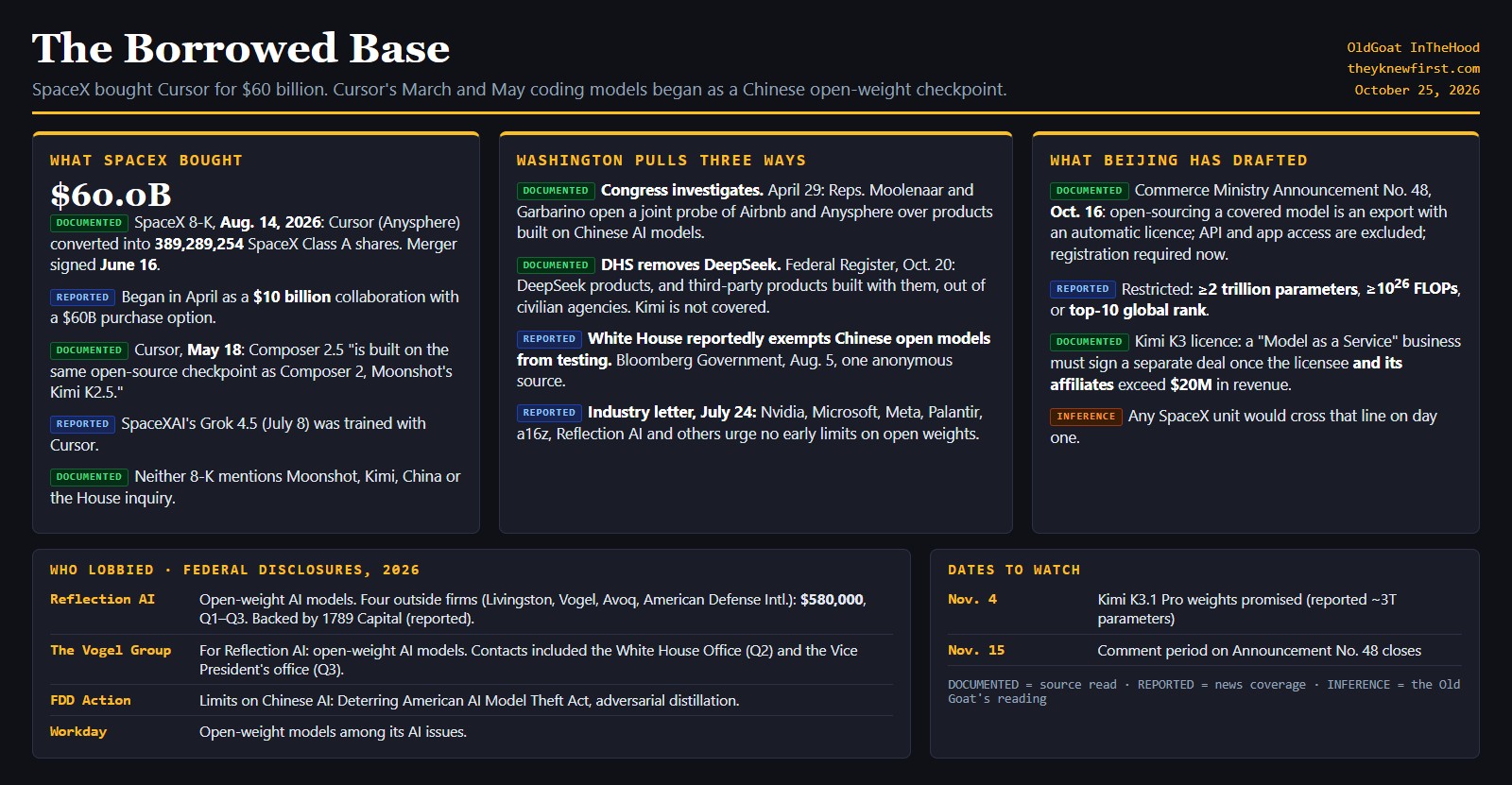
What SpaceX Bought
DOCUMENTED. On Aug. 14, 2026, SpaceX completed its purchase of Anysphere, Inc., the company that makes the Cursor coding tool. Its 8-K says Cursor's shares were converted into 389,289,254 SpaceX Class A shares "based on an implied equity value of Cursor of $60.0 billion," plus about 1.75 million shares for vested stock units. Cursor is now a wholly owned SpaceX subsidiary. The merger agreement was signed June 16. 8-K → Signing 8-K →
REPORTED. The deal began in April as a $10 billion collaboration that gave SpaceX the right to buy Cursor for $60 billion by year-end, pairing Cursor's product with the Colossus supercomputer that came with xAI. The Old Goat noted the option when it was announced, in Architecture of Permanence, Part 5. Musk's orbit is mapped on the Influence Orbit → page.
DOCUMENTED. Neither 8-K, the June 16 signing filing or the Aug. 14 closing filing, mentions Moonshot AI, Kimi, China or the House inquiry described below.
What Cursor's Model Is Built On
REPORTED. Cursor released Composer 2, its first in-house coding model, on March 19 without naming the model it started from. Within a day a developer found the model ID kimi-k2p5-rl-0317-s515-fast in Cursor's API traffic. Cursor then confirmed that Composer 2 started from Kimi K2.5, an open-weight model released by Moonshot AI of Beijing, and its co-founder Aman Sanger said the base should have been named from the start. Moonshot said Cursor's use ran through Fireworks AI "as part of an authorized commercial partnership."
DOCUMENTED. Cursor's own May 18 post on Composer 2.5 says it "is built on the same open-source checkpoint as Composer 2, Moonshot's Kimi K2.5." The same post says: "Together with SpaceXAI, we're training a significantly larger model from scratch, using 10x more total compute." Cursor →
DOCUMENTED. The Kimi K2.5 licence is the MIT licence with one change: a commercial product with more than 100 million monthly users or more than $20 million in monthly revenue must "prominently display 'Kimi K2.5' on the user interface." Licence → REPORTED: Cursor's annual revenue has been reported at $2 billion or more, which would be well over $20 million a month. INFERENCE: the public licence may not be what governs Cursor's use, because Moonshot describes a separate commercial partnership whose terms are not public. The Old Goat has not seen those terms.
REPORTED. On July 8, SpaceXAI released Grok 4.5, which it described as its first model trained with Cursor, and made it available on all Cursor plans. Whether Grok 4.5 is the from-scratch model the May post described, and whether Cursor's own Composer models still run on the Kimi base, has not been made public.
INFERENCE. When Cursor announced the from-scratch model "together with SpaceXAI," SpaceX already held the option to buy it. Four weeks later the merger was signed. The way out of the Chinese base now runs through SpaceX's own computers. For the March and May models, SpaceX bought a product whose in-house engine began as a Chinese checkpoint.
Washington Is Pulling Three Ways
Congress is investigating. DOCUMENTED. On April 29, Rep. John Moolenaar, chairman of the House Select Committee on the Chinese Communist Party, and Rep. Andrew Garbarino, chairman of the Homeland Security Committee, opened a joint investigation into Airbnb and Anysphere. Moolenaar's statement criticized "Airbnb and Anysphere's decisions to build their products on Chinese Communist AI models." The letter to Anysphere describes Moonshot as "one of the China-based companies publicly implicated in large-scale distillation campaigns." Committee → The Old Goat found no public report of what Anysphere told the committees.
The agencies are removing one Chinese lab. DOCUMENTED. On Oct. 20 the Federal Register published a Homeland Security order under the Federal Acquisition Supply Chain Security Act. It bars DeepSeek products from civilian agency purchases and orders the removal of DeepSeek products "and third-party products and services developed using DeepSeek implementations" from civilian agency systems. The notice is signed by DHS General Counsel James H. Percival II. Federal Register → REPORTED: the signed order itself is dated July 24, nearly three months before it was made public. The order names DeepSeek only. Cursor's base, Kimi, is a Moonshot model and is not covered.
The White House is reportedly exempting Chinese open models from testing. REPORTED, from one outlet citing people who spoke on condition of anonymity: Bloomberg Government reported Aug. 5 that the White House told U.S. AI companies at a closed-door meeting that Chinese-developed open-weight models would not be tested under its new AI security framework. The framework itself has not been published.
Industry asked Washington to go easy on open weights. REPORTED. On July 24, the same date reported for the DHS order, about 25 organizations released a letter titled "Open Weights and American AI Leadership," urging Washington not to restrict open-weight models prematurely. Coverage says the letter does not name China. Signers named in coverage include Nvidia, Microsoft, Meta, IBM, Dell, Palantir, CrowdStrike, Mistral, Hugging Face, Andreessen Horowitz, Y Combinator and Reflection AI. Later reports say the list grew to between 35 and 50, with OpenAI and Google among later signers; those accounts do not agree with each other, and the Old Goat did not find the letter's own signer page. Anthropic is consistently reported as not signing. The Old Goat draws nothing from the two July 24 dates beyond the fact that they match.
Who Lobbied
DOCUMENTED, from federal lobbying disclosures. The Old Goat searched second- and third-quarter 2026 reports for issue text mentioning open-weight models. Only two clients came up: Workday and Reflection AI, an American lab that builds open-weight models. Reflection hired four outside firms: The Livingston Group, The Vogel Group, Avoq and American Defense International. Together those firms reported $580,000 in fees from Reflection over the first three quarters, all listing open-weight AI models. In the third quarter, Vogel lobbied the Office of the Vice President, the Commerce, Defense and Treasury Departments, and both chambers. In the second quarter it lobbied the White House Office. Reflection's own reports list $290,000 of lobbying spending for the second quarter and $350,000 for the third, on "Artificial Intelligence Governance Issues and Open Models." A company's own total can include what it pays outside firms, so the two sets of figures should not be added. Vogel Q3 → Reflection Q3 →
DOCUMENTED. The restriction side shows up too. FDD Action, the lobbying arm of the Foundation for Defense of Democracies, reported $240,000 in lobbying spending for the second quarter and $210,000 for the third, across dozens of China-related bills. They include the Deterring American AI Model Theft Act (H.R. 8283), "Adversarial Distillation of American AI Models," and a proposed ban on Defense Department and intelligence-agency purchases of "Chinese-Made Synthetic Datasets for Training AI Models." FDD Action Q3 → The Old Goat did not search for every company lobbying on these bills.
REPORTED, in this site's It's a Hoax: Donald Trump Jr.'s 1789 Capital took early positions in SpaceX, Anduril, Cerebras and Reflection AI. DOCUMENTED, in The Silent Ad: an Andreessen Horowitz entity gave $50 million to the super PAC Leading the Future, per FEC records. Donors →
INFERENCE. The record shows companies with money riding on open weights, including one backed by the president's son's fund, paying for access on open-weight policy while the White House decided not to test Chinese open models. It does not show that any of them asked for that exemption, or who did. Reflection's filings name the issue, not the request.
What Beijing Has Drafted
DOCUMENTED, from the Ministry of Commerce's own Q&A on Announcement No. 48 of 2026, issued Oct. 16 with the Ministry of Science and Technology. Technology already made public "through open-sourcing or academic papers" is not meant to be covered. Open-sourcing AI technology counts as a technology export, but one that gets "facilitation measures such as automatic licensing," which the ministry calls, in effect, "report and export." Offering a restricted large model to foreign users through "API calls, app or web interaction, SaaS applications" or lightweight on-device deployment falls outside large-model export management. From Oct. 16 until the new catalogue takes effect, exporters must register listed technologies on a ministry platform before exporting them. MOFCOM →
REPORTED, from ChinaTalk's reading of the draft annex: a large model is restricted if it uses at least 1026 operations of training compute, has at least 2 trillion parameters, or ranks in the global top ten in public evaluations. Comments close Nov. 15.
DOCUMENTED. Moonshot's newer licence, for Kimi K3, is stricter than the one Cursor built on. Any licensee that runs a "Model as a Service" business must sign a separate agreement with Moonshot before any commercial use once "the aggregate revenue of the Licensee and its affiliates exceeds 20 million US dollars." Internal use and use through Moonshot's own products or certified partners are exempt. K3 licence → INFERENCE: the licence counts the revenue of affiliates, so any SpaceX unit would cross that line on its first day. Whether a given use counts as "Model as a Service" turns on definitions in the licence that the Old Goat cannot test from outside.
REPORTED. Moonshot's next model, Kimi K3.1 Pro, has been described as about 3 trillion parameters. For now it is available only through Moonshot's own service, with weights promised by Nov. 4. INFERENCE: at that size it would be over the draft's 2-trillion line. Whether the weights arrive on time, and under what licence, will be an early sign of how the new rule treats a big open release.
The Numbers, and Who Is Counting
REPORTED. Vercel, which routes developer traffic to many models, said open-weight models carried 56% of its gateway's tokens in August but about 14 cents of each dollar spent. A later Vercel update put September at 71.5% of tokens and nearly a quarter of spending. Those figures cover open models from every country, not only Chinese ones.
REPORTED. Two of the most quoted sources on this market have a stake in it. Andreessen Horowitz co-wrote OpenRouter's "State of AI" usage study, and together with Menlo Ventures it led OpenRouter's $40 million funding in 2025. Menlo, whose enterprise survey put Anthropic at 40% of corporate spending on language models, has invested in every Anthropic funding round since its Series D. The derivative counts in the investigation the Old Goat read, including 172,602 direct Qwen derivatives, are that investigation's own Oct. 25 measurement of the Hugging Face API. The Old Goat has not re-run them.
Dates to Watch
Nov. 4: Moonshot's promised date for the Kimi K3.1 Pro weights. Nov. 15: the comment period on Announcement No. 48 closes. After that, the next frontier releases from DeepSeek and Alibaba's Qwen will show whether the strongest Chinese models stay open, and under what terms.