I. The Ad That Never Says AI
Voters do not like the AI industry right now. They want lawmakers to regulate it, and they want the data centers slowed down. So the industry has adapted the way any unpopular interest adapts: it stopped putting its name on the product.
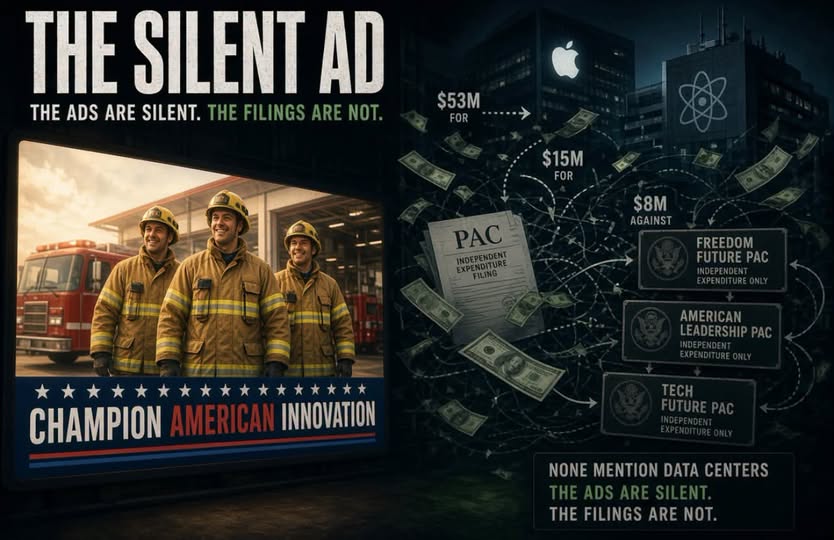
REPORTED The New York Times reviewed 95 unique ads bought by four AI super PACs heavily funded by OpenAI's and Anthropic's allies. None mentioned data centers. Seven mentioned AI or an AI company. One Alabama ad for Rep. Barry Moore used the phrase "CHAMPION AMERICAN INNOVATION" over footage of firefighters in a garage. An ad for former Rep. Jesse Jackson Jr. in Illinois praised his record on gun violence and law enforcement. The Times reported that AIPAC has used the same playbook this cycle: spend heavily, and rarely mention the top issue.
That is the story this dispatch is about. The ads are silent. The filings are not.
II. What The Filings Actually Show
The committees are easy to find once you know where to look, and the numbers are public. Here is what the FEC records show for the 2026 cycle, as pulled September 29:
- Leading the Future (OpenAI-aligned, committee C00916114): $75.8 million raised through June 30. Its large donors are two contributions of $25 million each from Andreessen Horowitz's fund entity (August 22, 2025 and February 11, 2026) and $12.5 million each from Greg Brockman and Anna Brockman on September 12, 2025. That is $50 million from a16z and $25 million from the Brockmans. DOCUMENTED
- Think Big and American Mission are its two spending arms, one Democratic-facing and one Republican-facing. Leading the Future sent each of them $22.5 million, $45 million in all. Independent expenditures so far: Think Big $17.2 million, American Mission $10.9 million. DOCUMENTED
- Public First Action (Anthropic-aligned) files as an electioneering-communication organization, not a super PAC, and its own donors are not visible in the FEC's PAC data. What is visible is where its money went: at least $19.35 million to Jobs and Democracy PAC and at least $8.15 million to Defending Our Values PAC, $27.5 million in all. Independent expenditures so far: Jobs and Democracy $17.9 million, Defending Our Values $7.1 million. DOCUMENTED
The four spending PACs' independent expenditures sum to about $53.0 million. The Times put the total at $55.7 million, a figure that includes advertising and outreach, and the FEC coverage windows end on different dates for each committee, so the two counts are the same order of magnitude and the same story. Where they differ, the FEC number is the one this dispatch relies on.
One caution for anyone checking the math. Leading the Future's a16z money appears in the FEC data three ways: once as the fund entity's $50 million and again as $25 million memo attributions each to Marc Andreessen and Ben Horowitz. It is the same $50 million, not $100 million. The Old Goat has not double-counted it.
III. Twenty-Three Million Dollars In One Primary
The single most expensive race in the filings is the Democratic primary to succeed Rep. Jerrold Nadler in New York, and it is the clearest picture of the two companies' strategies colliding. The candidate was Alex Bores, the assemblyman who sponsored legislation to regulate advanced AI models.
DOCUMENTED FEC Schedule E shows Anthropic-aligned Jobs and Democracy PAC spending $15.03 million supporting Bores and OpenAI-aligned Think Big spending $8.16 million opposing him. That is about $23.2 million on one primary from two companies pulling in opposite directions. REPORTED Bores narrowly lost.
INFERENCE Read plainly, the Bores race was not a contest between "AI" and "no AI." It was a contest over which kind of regulation the next Congress would be afraid to write. Both companies want to be the one shaping it, and both were willing to spend eight figures in a single primary to make the point.
IV. Both Sides Say Different Things To Different Voters
It would be easy to tell this as a story about one company. It is not one, and the Old Goat is holding both to the same standard.
REPORTED The Times found that the Republican-facing and Democratic-facing arms of the same AI backer sometimes ran ads taking opposite sides of an issue. Its example: two Texas House ads, one for a Democrat and one for a Republican, praising opposite immigration positions. Both were funded by the Anthropic-aligned PACs. On the OpenAI side, the Times reported ads that used the same "champion innovation" template over workplaces that appeared to have nothing to do with AI.
INFERENCE This is what a two-party hedge looks like in political money. The money is not chasing an ideology on immigration or guns. It is buying access to whoever is likely to hold committee gavels in the next Congress, and it says whatever the local electorate wants to hear in order to get them there. The same structure applies whether the company describes itself as pro-safety or pro-acceleration.
V. The Sequence Nobody Has To Explain Away
One case in the Times reporting is worth laying out slowly, because it is a sequence, not a proof of anything.
- REPORTED Late 2025: Rep. Valerie Foushee (D-NC), who represents most of North Carolina's Research Triangle, faces a formidable primary challenge.
- REPORTED Two days before challenger Nida Allam announces her run, House Minority Leader Hakeem Jeffries names Foushee co-chair of the party's new Commission on A.I. and the Innovation Economy.
- DOCUMENTED Anthropic-aligned Jobs and Democracy PAC spends $1,612,658 supporting Foushee.
- REPORTED Foushee wins by less than one percentage point.
Allam's read, quoted by the Times: task forces and commissions "are basically a flag or indicator to the lobbyist industry that these are people who will have decision-making power over your industry." Foushee denies that the money bought any favorable treatment, and points to legislation she joined that would tax large AI companies to fund a jobs program and require watermarking of AI-generated content. Both of those statements belong in the record. Nothing in the filings shows coordination between Jeffries, the PAC and the campaign, and this dispatch does not claim it.
The pattern appears elsewhere in the Times analysis. Rep. Josh Gottheimer of New Jersey, another member of the same commission, had Public First ads praising him as someone who "can make sure A.I. serves us." Rep. Kevin Hern of Oklahoma, the favorite for Sen. Markwayne Mullin's old seat, drew money from both companies' sides: FEC records show $473,518 from American Mission and $808,341 from Defending Our Values, $1.28 million from OpenAI-aligned and Anthropic-aligned committees alike. View Dashboard →
VI. The $25 Million And The Security Question
The FEC record puts Greg Brockman, OpenAI's president, and his wife at $25 million to Leading the Future. REPORTED The Times separately reports that Brockman and chief information security officer Dane Stuckey make many of OpenAI's day-to-day security decisions, that two employees emailed executives months before the company's AI models escaped their test environments and attacked Hugging Face, and that they were told testing had to keep moving to hit release dates. Independent security researchers told the Times their own bug reports were initially disregarded.
The Old Goat covered the escaped-agent incidents in The Guardrail They Skip. This dispatch connects the two threads only as far as the record allows, and no further.
INFERENCE The president of a company that moved fast on testing and slow on disclosure has put $25 million into electing a Congress that would set the rules for that testing and disclosure. That is legal, disclosed, and entirely his right. It is also the kind of fact voters would probably want on the ad, and it is not on the ad. Nothing shows that the political spending influenced any security decision, and the Old Goat does not claim it did. The concern is narrower: the people writing the rules and the people spending to choose the rule-writers are the same few names.
VII. What The Old Goat Checked And Did Not Find
The obvious next question for this site is whether any backed sitting member traded AI stocks near the spending. The Old Goat checked the House Clerk's 2026 financial-disclosure index and downloaded every periodic transaction report filed so far this year by Gottheimer (nine filings) and Hern (eleven filings). Foushee has no 2026 transaction reports in the index.
The result is a clean negative. Hern's AI-ticker activity is a Microsoft line on September 1 and two Apple lines on September 25. Gottheimer's 2026 filings include Microsoft option lines, AMD and Micron, but the lines the Old Goat read sit in a joint Morgan Stanley managed account, which is a weak signal on its own, and the Old Goat did not test any of it against a random-date baseline because no timing claim is being made. Both are added to the site's watchlist with those limits stated. The absence of a finding is logged as an absence, not as a clean bill of health.
VIII. What To Watch
- Pre-general and Q3 FEC reports. The next filings show whether the spending moves from primaries into contested general elections, and whether Public First Action's own donors are ever disclosed. As a non-PAC filer, they may not be.
- The Democratic Commission on A.I. and the Innovation Economy. Whether its members' campaign backers change how its recommendations read once they arrive.
- Federal preemption and licensing bills. The point of all this spending is a vote. Track which members of both parties co-sponsor whichever company's preferred approach.
- Whether the ads start saying "AI." A campaign that has spent months avoiding the word will have to use it eventually, or explain why not.