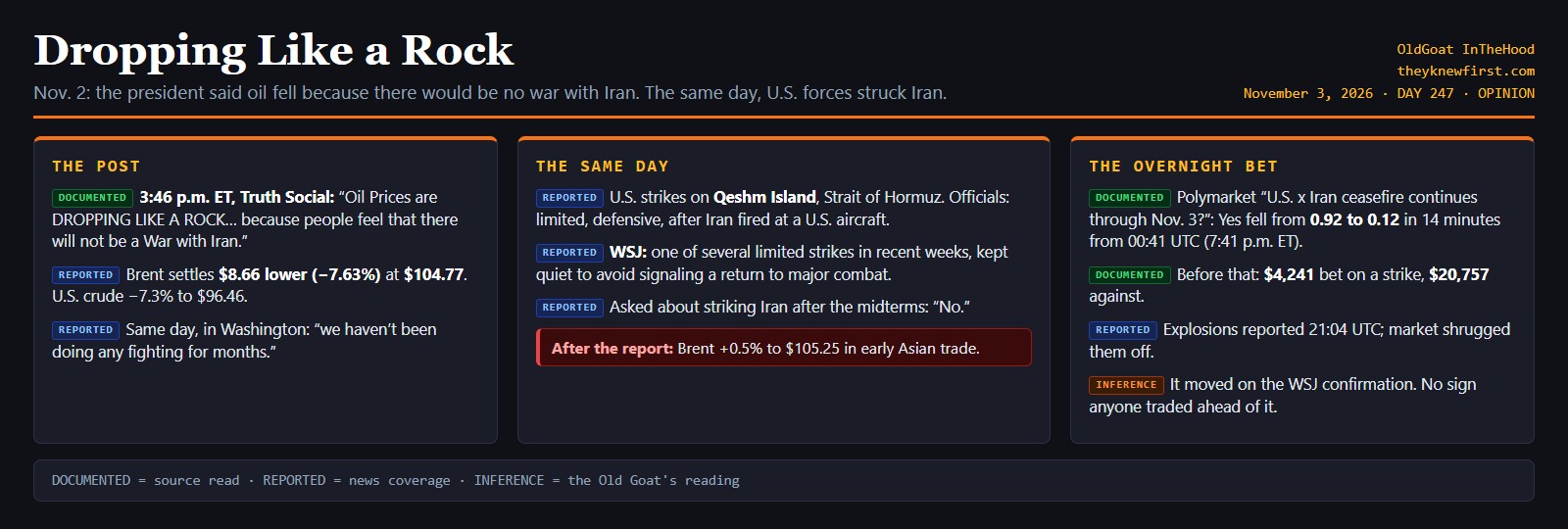
The Post
DOCUMENTED. At 3:46 p.m. Eastern on Monday, Nov. 2, the president posted on Truth Social: "Oil Prices are DROPPING LIKE A ROCK, down almost $10 a Barrel, A RECORD, because people feel that there will not be a War with Iran. Iran wants a settlement, as soon as possible. It could happen!" Post →
REPORTED. Brent crude settled $8.66 lower that day, down 7.63 percent, at $104.77 a barrel. U.S. crude fell 7.3 percent to $96.46. CNBC tied the sell-off to hopes for peace talks ahead of the midterms. The president had told reporters Iran wants to "make a deal and that could happen," and reports said Iran was talking through mediators, including Qatar and Pakistan, about reopening the Strait of Hormuz. CNBC → NBC →
REPORTED. In Washington the same day, in a speech billed as his closing argument, he said: "I don't know if you even call it a war, because we haven't been doing any fighting for months" (AP). Asked whether he would strike Iran after Tuesday's elections, he said "No" (Reuters). NBC reports he had said earlier that the U.S. "would not launch strikes on Iran" before the midterms. AP →
The Same Day
REPORTED. On Nov. 2 the U.S. military struck Qeshm Island, the largest island in the Strait of Hormuz. The Wall Street Journal broke the story, citing U.S. officials, and called it one of several limited strikes carried out in secret in recent weeks, kept small and kept quiet to avoid signaling a return to the major campaign. Per the Journal, the island holds an underground missile site, a naval base and a desalination plant. Iranian state media reported five explosions. Reuters →
REPORTED. U.S. officials told NBC News the strikes were "not a resumption of major combat operations in Iran." One said the U.S. is "occasionally striking Iranian missile launchers in self-defense" when the Revolutionary Guard fires at U.S. aircraft; another said Iran "tried to target a U.S. aircraft again," and the strike was "to take out the launcher." Axios, citing a U.S. official, reported that a U.S. fighter jet destroyed a Guard surface-to-air missile launcher. NBC notes the administration "was last known to have carried out some attacks in early September." NBC →
REPORTED. Vice President JD Vance said "we've had a number of good conversations with the Iranians." Iran's foreign minister, Abbas Araghchi, wrote that "Iran continues to give diplomacy a chance to succeed." Thousands of U.S. troops remain off Iran enforcing a naval blockade, and NBC reports a third aircraft carrier is on its way. Administration officials told the Journal the president was still weighing his options.
The Overnight Bet
REPORTED. Once the Journal's report was out, oil turned around: Brent rose 48 cents, to $105.25, in early Asian trade on Tuesday (CNBC). CNBC →
DOCUMENTED. Polymarket runs a market called "US x Iran ceasefire continues through November 3?" It pays "No" if the United States carries out an air or missile strike that directly hits Iran's territory by the deadline. It opened at 17:26 UTC on Nov. 2. By the Old Goat's count of Polymarket's public trade records, before 00:40 UTC on Nov. 3 (7:40 p.m. Eastern on Nov. 2), traders put about $4,241 on a strike and about $20,757 against one. The largest single bet on a strike in that stretch was $354. Polymarket → Markets tab →
DOCUMENTED. Then the price broke. "Yes" (no strike) traded at 0.92 at 00:40 UTC, 0.30 at 00:44 and 0.12 at 00:55. Over the next six hours, buyers put about $174,000 on a strike. By 04:10 UTC "Yes" was near a penny.
REPORTED. The explosions were public hours before the price broke. At 00:34 Tehran time on Nov. 3 (21:04 UTC, 4:04 p.m. Eastern on Nov. 2), the Iranian site Asriran posted, citing IRNA, that five explosions had been heard on Qeshm "a few minutes ago." That was eighteen minutes after the president's post. By 21:48 UTC, investingLive was relaying Israel's N12 that a U.S. strike had hit an air-defense system on the island. Asriran → investingLive →
DOCUMENTED. The betting market did not believe them. "Yes" slipped from about 0.97 at 20:49 UTC. One thin print hit 0.27 at 20:55, and the price touched 0.78 at 21:12, but by 21:22 it was back above 0.9. In the hour from 21:00 to 22:00 UTC, traders put about $12,500 on no strike and about $2,600 on a strike. From 23:19 UTC to 00:40 UTC, strike bets totaled $74.
DOCUMENTED. The break came at 00:40:40 UTC, when five different accounts bought "No" within five seconds, none for more than $131. Many small buyers moving in the same seconds is what a shared public trigger looks like, such as a headline or an alert. It does not look like one informed account getting in early.
REPORTED. The Journal's story carried the first confirmation from U.S. officials. The Old Goat could not read the Journal's own time stamp, which is behind its paywall. The bounds are tight. A roundup of fifteen outlets posted at 23:19 UTC cites IRNA but not the Journal. The earliest relays of the Journal story found carry time stamps of 01:05 UTC (Reuters, via Yahoo), 01:07 (Newsmax) and 01:11 (Iran International).
INFERENCE. The Journal most likely posted around 00:40 UTC (7:40 p.m. Eastern), and the market moved on it within seconds. The tape shows no sign of anyone trading ahead of the news. The early strike bets, $354 at most, came as explosions were being heard on the island. One more detail: Iranian media placed the explosions after midnight Tehran time, past the deadline of Polymarket's separate "through November 2" market. That may explain why that market was still trading at 74 percent "Yes" the next morning.
| Time (UTC) | Eastern | What happened |
|---|---|---|
| 20:46:30 | 3:46 p.m. | Truth Social: oil "DROPPING LIKE A ROCK" because there will be no war with Iran (DOCUMENTED) |
| ~20:50–21:04 | ~3:50–4:04 p.m. | Five explosions heard on Qeshm; Asriran posts IRNA report at 21:04 (REPORTED) |
| 20:49–21:23 | 3:49–4:23 p.m. | Polymarket "no strike" wobbles (one print at 0.27, low trades at 0.78), back above 0.9 by 21:22 (DOCUMENTED) |
| Close | Close | Brent settles $104.77, down $8.66 (REPORTED) |
| 21:48 | 4:48 p.m. | Israel's N12, via investingLive: U.S. strike hit an air-defense system (REPORTED) |
| 23:19 | 6:19 p.m. | Roundup of 15 outlets cites IRNA, not the Journal (REPORTED) |
| 00:40:40 | 7:40 p.m. | Five accounts buy "No" within five seconds; price falls from 0.92 to 0.12 by 00:55 (DOCUMENTED) |
| 01:05–01:11 | 8:05–8:11 p.m. | Earliest time-stamped relays of the Journal's report (REPORTED) |
| 01:04 | 8:04 p.m. | Brent up 0.5% to $105.25 in early Asian trade (REPORTED) |
The Old Goat's Two Cents
OPINION. On the day the president told the country there would be no war, the biggest commodity market in the world fell almost eight percent on that hope, and he took a victory lap for it. On the same day, his own officials were striking Iran, as part of what the Journal calls a run of limited strikes in recent weeks that were kept from the public on purpose. "We haven't been doing any fighting for months" and "several strikes in recent weeks" cannot both describe the same war.
OPINION. Nobody in this dispatch is accused of trading on it. The point is simpler. When the public price of oil rests on the president's word, and the government knows things that word leaves out, the people who knew first are the people inside. The betting market caught up after dark, in about fifteen minutes.
OPINION. Six days ago Short of Sixty-One → said to watch for a strike on Iran after Nov. 3. It came a day early and was called defense, not war. The Old Goat's Iran War Intel → tab tracks the markets that move first; After the Vote, Under the Dark → has the earlier reporting on plans for strikes after the vote.