VELOCITY · IRAN WAR · DAY 242 · OPINION · OCTOBER 29, 2026 · UPDATED NOVEMBER 16, 2026
Short of Sixty-One
Israel voted on Oct. 27, the day after reports that Netanyahu pushed for a new strike on Iran before the polls opened and his army chief pushed back. With most votes counted, neither bloc has a majority, Likud says Arab parties "stole" the election, and official results come Nov. 4. The coalition math now runs straight into the war calendar.
OldGoat InTheHood · theyknewfirst.com · October 29, 2026
53 · 48 · 19RESULTS NOV. 4OPINION LABELED
HOW TO READ THIS. Seat counts are REPORTED partial results, not official ones. Outlets differ by a seat here and there, and roughly 430,000 to 480,000 "double envelope" ballots from soldiers, police, prisoners, patients and diplomats were still being counted on Oct. 29. The strike reports come from the New York Times, CNN and Channel 12, all citing unnamed officials, and the Israeli government denies them. The Old Goat's views are labeled OPINION.
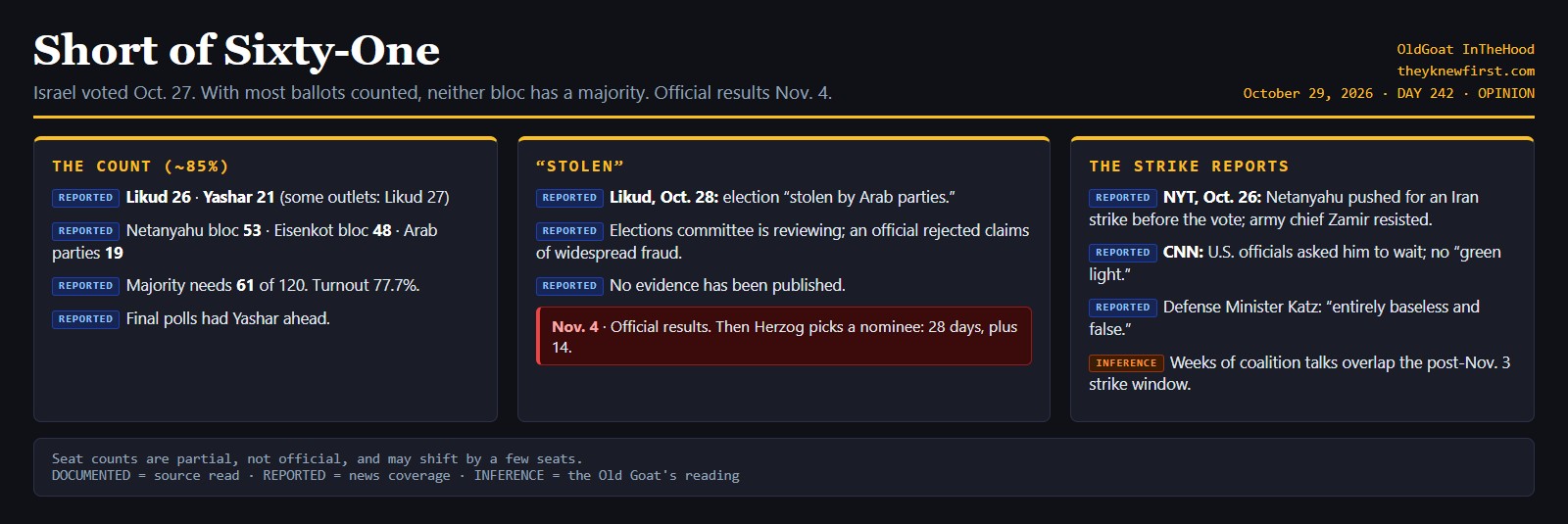
Summary card of the facts below, with the same DOCUMENTED / REPORTED / INFERENCE labels.
The Count
REPORTED. With about 85 percent of the vote counted on Oct. 28, Likud led with 26 seats and Gadi Eisenkot's Yashar had 21. By bloc, Netanyahu's coalition parties had 53, the parties around Eisenkot 48, and the Arab parties 19. A government needs 61 of the Knesset's 120 seats. Some outlets give Likud 27. Turnout was 77.7 percent, the highest since 1999. Ynet →Jewish Chronicle →
REPORTED. The polls had it the other way. The final Kan 11 survey before the vote put Yashar at 22 seats and Likud at 20, with Eisenkot's bloc ahead 52 to 50. Both main exit polls instead put Likud first.
REPORTED. The last ballots are the double envelopes. Counting began overnight and was expected to finish Thursday evening, Oct. 29. The head of the Central Elections Committee said their distribution is generally similar to the national vote, with "no significant deviations." They can move a few seats between parties. Analysts do not expect them to hand either side 61. Times of Israel →
REPORTED. Official results are due Nov. 4. President Isaac Herzog then consults every party and names the member most likely to form a government, who need not lead the largest party. That nominee gets 28 days, extendable by 14. If no one succeeds, a second candidate can try, and failing that Israel votes again, likely around the end of the year. Al Jazeera →
"Stolen"
REPORTED. On Oct. 28 Likud issued a statement: "The elections in Israel were stolen by Arab parties that support terror and the elimination of the Jewish state." It called for a "thorough investigation" and said it would give the police, the Shin Bet and the elections committee hundreds of items, including alleged bribery, threats and ballot envelopes. Netanyahu had said on election day that Arab voters were "stealing" the election. No evidence has been published.
REPORTED. The committee said it "received Likud's request and is reviewing it." A committee official told Channel 12 it rejected claims of widespread fraud. A day earlier it had found "no indication" of systematic ballot tampering in complaints from three other parties.
The Strike That Wasn't, Yet
REPORTED. On Oct. 26, the day before the vote, the New York Times reported that Netanyahu had pushed for a new strike on Iran before the election and that the military's chief of staff, Lt. Gen. Eyal Zamir, resisted. The paper cited three senior defense officials and three others briefed on the talks. It said Zamir did not oppose action against Iran in principle but questioned the urgency and the timing, and that the air force commander also raised concerns. Five of the sources said fighting with Iran could resume in the coming weeks. Ynet →
REPORTED. Channel 12 reported that Zamir asked for further discussion and for signed legal authorization from the political leadership before any operation. CNN, citing two U.S. officials and an Israeli defense official, reported that U.S. officials asked Netanyahu to put off strikes, and the Israeli official said the president "did not give a green light." Defense Minister Israel Katz called reports of a rift "entirely baseless and false" and said Israel had no plan to attack Iran before the election. The prime minister's office called the CNN report "fake news." Gulf News →
REPORTED. In the campaign's last days Netanyahu said "Iran is weaker than ever" and spoke of a "one-time opportunity," with the president, to remove the Iranian threat. Earlier in October the Times had reported that the U.S. and Israel have plans for strikes after the American midterms. After the Vote, Under the Dark →
The Old Goat's Two Cents
OPINION. Two calendars now overlap. Israel's runs from Nov. 4 through a month or more of coalition talks, and Netanyahu stays prime minister the whole time. Washington's runs past Nov. 3, the date the president promised no strikes before. A caretaker leader who reportedly wanted a strike before the vote, facing a count that leaves him short, now has weeks in office with no election in the way.
OPINION. The word "stolen" is doing work here. When the gap between the blocs is smaller than the 19 seats Arab parties won, calling those votes illegitimate is a way to shrink the denominator. The Old Goat has heard that argument in another country. It did not hold up there either.
OPINION. None of this says a strike is coming. It says the brakes that held last weekend, an army chief asking for signatures and an American president withholding a green light, are the brakes to watch. The Old Goat's Iran War tab tracks the markets that move first. Iran War Intel →
Update · October 29, 2026, evening · Likud 27
REPORTED. Later on Oct. 29, as the double-envelope ballots were counted, Likud gained a seat at the expense of its ally Shas: Likud 27, Yashar 21, Together 12, Joint List 11, Democrats 8, Ra'am 8, Yisrael Beytenu 7, Otzma Yehudit 7, United Torah Judaism 7, Religious Zionism 6, Shas 6. The blocs did not move: 53 for Netanyahu's, 48 for Eisenkot's, 19 for the Arab parties. The Reservists and the Economic Party fell below the 3.25 percent threshold. The Times of Israel reported the double-envelope count still under way that afternoon. Official results remain due Nov. 4. Times of Israel →INN →
Update · November 3, 2026 · The strike came a day early
REPORTED. This dispatch said to watch for a strike on Iran after Nov. 3. On Nov. 2, U.S. forces struck Iran's Qeshm Island in the Strait of Hormuz. U.S. officials called it limited and defensive, a response to Iranian fire at a U.S. aircraft and "not a resumption of major combat operations" (NBC News). The Wall Street Journal called it one of several limited strikes in recent weeks, kept quiet on purpose. That afternoon the president had posted that oil was "DROPPING LIKE A ROCK" because "there will not be a War with Iran." The full account: Dropping Like a Rock →
Update · November 4, 2026 · The final count, and the bid to stop it
REPORTED. The Central Elections Committee's final results match the Oct. 29 evening count: Likud 27, Yashar 21, B'Yachad 12, Joint List 11, Democrats 8, Ra'am 8, Yisrael Beytenu 7, United Torah Judaism 7, Otzma Yehudit 7, Shas 6, Religious Zionism 6. Netanyahu's bloc has 53, Eisenkot's 48, the Arab parties 19. The new Knesset is due to be sworn in Nov. 10. Times of Israel →
REPORTED. On the fraud claim: the committee says its review of 9,069 polling stations, about 75 percent of regular voting places and far more than after the last election, found no discrepancies indicating a breach of integrity or a change in the results. Chairman Noam Sohlberg called the review unprecedented in scope (Ynet). Ynet →
REPORTED. Likud then asked to delay certification, citing a Shin Bet and Mossad probe into alleged foreign interference, said to center on claims that Qatar or other foreign powers funded efforts to raise Arab turnout; the claims have not been substantiated. All 16 committee members from Netanyahu's bloc signed a letter saying "We see no possibility of publishing the election results before a discussion is held." Sohlberg refused: "neither the plenum nor anyone else has the legal power to delay the publication of the official election results." He said claims of wrongdoing belong in the courts. The certified results were slated to go to President Herzog on Nov. 4, after which he consults the parties (Times of Israel). Times of Israel →
OPINION. The count did not move, and the audit found nothing. The fight has moved from the ballots to the calendar: every day certification slips is a day longer for the outgoing government, the point Sohlberg made when he refused.
Update · November 6, 2026 · 67 to 46
REPORTED. President Herzog accepted the certified results on Nov. 4: "The elections are over. Now is the time to face reality" (Al Jazeera). After two days of consultations he said factions with 67 of the 120 seats recommended Gadi Eisenkot to form the next government and factions with 46 recommended Netanyahu. Eisenkot's 67 include Yashar, B'Yachad, Yisrael Beytenu, the Democrats, the Joint List and Ra'am. United Torah Judaism's seven seats did not back Netanyahu. Herzog called the result "clear" but said the law requires him to judge who can actually form a government, and that he will name his nominee on Sunday, Nov. 8. The nominee then has 28 days, extendable by 14 (Times of Israel). Times of Israel →Al Jazeera →
REPORTED. The attorney general turned down a request to question elected officials over the interference claims without supporting evidence, and the elections committee found "no evidence of irregularities that compromised the integrity of the election or affected its results" (Al Jazeera). Likud's Miri Regev called Eisenkot's camp a "disaster bloc" and the party urged a "broad national government."
OPINION. "Short of Sixty-One" was the headline because no bloc reached 61 on its own. Counting the Arab parties, one candidate now has 67 recommendations. The question this dispatch raised still stands: Netanyahu stays prime minister until a new government is sworn in, and the war calendar does not wait for coalition talks.
Update · November 16, 2026 · Eisenkot gets the mandate
REPORTED. President Herzog formally tasked Gadi Eisenkot with forming the next government on Sunday, Nov. 8, at the President's Residence, after announcing the choice the night before. Eisenkot has 28 days, which by the Old Goat's count runs to about Dec. 6, and Herzog can add up to 14 more. If he fails, the president can give another member of the Knesset a single 28-day try (JNS, Israel Hayom). Standing beside Eisenkot, Herzog said "Iran did not stop for a second with its threats" and called it an issue that "must be dealt with immediately," according to Al Jazeera's live coverage. JNS →Israel Hayom →
REPORTED. The day before, Nov. 7, U.S. Central Command set up Task Force Iron Gate, a team of about 20 based in Tampa, to choke off Iran's land routes and Caspian Sea shipping for weapons and sanctioned goods, extending the naval blockade. CENTCOM says the blockade has kept more than $25 billion in Iranian crude off the market. No Iron Gate seizure had been reported as of Nov. 8. Al Jazeera →Iran tab →
OPINION. The man who keeps the war file until a new government is sworn in is still Netanyahu. The clock to watch is Dec. 6.
Ongoing Review
The Old Goat will revisit this dispatch from time to time to verify what's written here, and leaves it to the reader to draw their own conclusions from the information presented. Watch items: Eisenkot's 28-day clock (about Dec. 6, extendable by 14 days); the Shin Bet and Mossad interference finding and any court case over it; the Nov. 10 swearing-in; any further U.S. or Israeli strike on Iran.
Fifty-three, forty-eight, nineteen, and a war waiting on the count.
Behind the curtain, no wizard to find. Just a thunder organ, a wallet, and scaffolding left behind.
The noise is the point. The scaffolding is the story.
Confirmed Sources
REPORTED — Ynet and The Jewish Chronicle live coverage, Oct. 28, 2026: party and bloc counts at ~85 percent; Likud statement; elections committee responses. link
REPORTED — Times of Israel, Oct. 28–29, 2026: double-envelope ballots and timing. link
REPORTED — Al Jazeera, Oct. 27–28, 2026: turnout, process after Nov. 4. link
REPORTED — New York Times, Oct. 26, 2026, via Ynet and Gulf News; CNN; Channel 12: the pre-election strike reports and denials. link
REPORTED — Jerusalem Post, Oct. 2026: final pre-election polls. link
INFERENCE — The views above are the Old Goat's opinion.