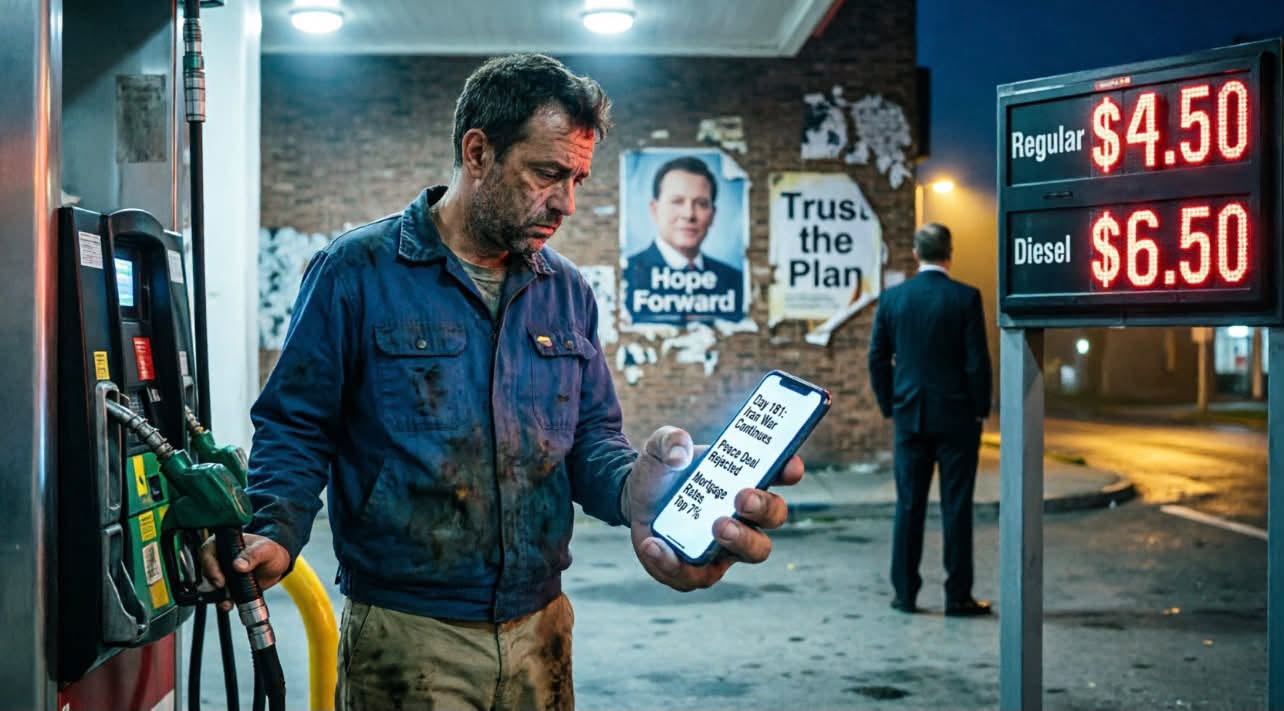
Six months ago today, American and Israeli forces struck Iran, killing Supreme Leader Ali Khamenei and much of the country's senior military leadership within hours. A strike on a school in Minab killed scores of children on that first day. President Trump told Americans it would be over in four to five weeks. It is Day 181. In central Oklahoma, the largest private oil storage complex in the country is close to the emptiest it has been in years. The federal Strategic Petroleum Reserve is at its lowest level since 1982. And the bill for all of it is starting to run into the same wall as everything else on this dashboard: a government that is borrowing $2 trillion a year to pay for a war it said would be brief.
The Shortage That Isn't Crude
Cushing, Oklahoma's tank farms held 22 million barrels as of late August -- just above the minimum operating level, per the EIA. Draw them down further and the equipment itself risks damage. Persian Gulf producers, meanwhile, are looking to build oil storage overseas, deliberately away from the Strait of Hormuz. "Producers need to invest in storage that is not necessarily in their country," said Amos Hochstein, a senior energy adviser in the Biden administration -- a straightforward acknowledgment that the strait itself can no longer be treated as reliable, by people with no reason to spin it either way.
But the tighter constraint isn't crude supply at all. It's refining. On Thursday, average U.S. diesel prices sat just 7 cents below this year's peak, according to AAA -- even as crude has room to spare. That is the same refining-capacity bottleneck flagged in Written in Pencil: it is the specific problem the EPA's early end to summer-blend gasoline rules was built to address, and the same "crack spread" divergence between crude and refined-product prices flagged there. Reopening the strait, even fully, would not by itself bring the price at the pump back down.
The Bond Market Is Running the War
This part of the picture is by now well established across multiple independent sources already logged on this dashboard: Bessent's Tokyo yen intervention, the doubled Treasury bond buyback that lost its effect within 24 to 48 hours, and Trump's own answer when asked directly whether he'd order further intervention -- "We have many types of intervention … the ultimate intervention is our military, and if we have to use that, we will." He said it laughing. Financial reporters did not find it funny. View The Bessent Pattern → View The Debt Spiral →
"Why would I want to blow up the global financial system?" — Treasury Secretary Scott Bessent, explaining why sanctions against countries still trading with Iran are being phased in rather than imposed immediately.
The throughline: fiscal and monetary tools are being visibly, repeatedly deployed to manage the economic fallout of a war that was supposed to be short. The 30-year yield has more practical say over the next three months of White House behavior than most of what comes out of the Situation Room.
The $300 Billion Question
A reported $300 billion Gulf-funded redevelopment arrangement, tied to a ceasefire MOU and described in one analysis as including "Strait of Hormuz fees," is already an open thread on this dashboard The Fund That Isn't a Fund -- flagged there as REPORTED, not DOCUMENTED, since the claim that Kushner and Witkoff would personally collect management fees from it traces to a single opinion source, not a named official or primary document.
The instinct to test that fund against U.S. fiscal reality is the right one, but the specific comparison needs a correction before it goes further. As reported, the $300 billion was described as Gulf-sourced capital, with the U.S. "involved in administering" it -- not a direct outlay from the U.S. Treasury. That means the fund's plausibility doesn't rise or fall on whether Washington can personally afford to write a $300 billion check; it rises or falls on whether Gulf states actually commit the money, and on what the U.S. role in administering it is actually worth to whoever holds that role.
What is real, specific, and worth using on its own terms: the Supreme Court's Feb. 20, 2026 ruling in Learning Resources, Inc. v. Trump struck down the tariffs imposed under IEEPA, and estimates of what the government may now owe in refunds run $160 billion to $175 billion. The administration has signaled it does not intend to refund voluntarily; more than 2,000 lawsuits are pending; interest on the disputed amount has been accruing at roughly $650 million a month under at least one court order. That is a documented, unresolved contingent liability -- not a completed payout, but a real one, and it is the actual mechanism connecting the Canada tariff fight to the government's shrinking room to maneuver.
Kushner and Witkoff: Two Readings, Not One
There's a structural version of this story worth taking seriously: the U.S. needs continued foreign capital, including Gulf capital, to keep rolling $40 trillion in debt at rates it can tolerate. Peace deals, trade arrangements, and sovereign wealth fund relationships are, at that level, a real financing mechanism for a country whose domestic capacity to fund its own obligations is visibly strained -- not just a backdrop for individual enrichment.
But that structural reading doesn't replace the individual one already documented elsewhere -- it sits on top of it. Kushner's Affinity Partners has collected tens of millions of dollars in fees from the UAE, Saudi Arabia, and Qatar while Kushner simultaneously negotiates matters affecting those same governments, a pattern reported independently of anything to do with Iran. View Orbit Map → If the country genuinely depends on that capital relationship structurally, a named individual personally profiting from managing it is not a smaller problem than pure self-dealing. It's arguably a sharper one: the leverage runs both ways, and only one side of it is getting paid a fee.
Six Months, By the Numbers
Eighteen U.S. service members killed, more than 750 wounded, since the war began. At least $37.5 billion in direct cost so far. Trump has said a deal to end the war was close at least 38 times, per CNN's own tracking of his interviews, social posts, and public remarks. This week he posted an AI-generated image declaring "MISSION ACCOMPLISHED 2026." Iran is currently negotiating with Oman over a temporary alternate shipping route around the strait -- itself an acknowledgment from Tehran's side that the blockade is holding well enough to require a workaround.
Only a handful of Republicans have said anything on the record. Rep. Thomas Massie, who lost his own primary to a Trump-backed challenger this year, posted on the anniversary: the War Powers Act required withdrawal after 90 days absent congressional authorization; the administration's own workaround was to claim the war stopped and restarted at day 91; "We are past 180 days. End the War."
In Tehran, the register is different. "People are hungry, confused and unable to find a way out," one artist told the Times. Six months in, the expectation inside Iran has shifted from hoping the war forces political change to simply surviving the economic wreckage it has caused -- a war that, on the U.S. side, is now being managed as much through Treasury interventions and tariff litigation as anything happening in the strait itself.
The Party Turns
By late September, the war had become a midterm liability inside the president's own party. Rep. Ashley Hinson, the GOP's Iowa Senate nominee, called at a Friday news conference for an "immediate" end to the war, saying she was "incredibly frustrated" by rising costs. Former Rep. Mike Rogers, the Republican nominee in Michigan's Senate race and a longtime foreign-policy hawk who called the war a "win-win-win" back in May, released an ad declaring it "needs to end." Senator Jon Husted of Ohio said flatly, "we got to bring the war to a close." Nebraska House hopeful Brinker Harding said the same, "as quickly as possible."
None of that changed their votes. Hinson and Husted both voted against measures to limit the president's war powers. Seven House Republicans, Iowa's Zach Nunn and Mariannette Miller-Meeks among them, broke ranks to support ending the war or requiring congressional authorization. The rest of the party overwhelmingly did not, despite polling showing fewer than a third of likely midterm voters think going to war was the right call.
The president has offered three statements on this that do not sit easily together. In May, asked whether Americans' financial situation was motivating him to make an Iran deal, he told reporters, "not even a little bit... I don't think about Americans' financial situation. I don't think about anybody." In September, at the UN General Assembly, he said the election "doesn't even enter my mind" when it comes to Iran. Minutes later, in the same speech, he said he expects a deal "right after the election," because Iran is "waiting to see how I do in the midterm election." If the election truly doesn't enter his mind, there's no reason he'd expect it to enter Iran's.
Days later he confirmed he'd rejected Iran's latest proposal: reopen the Strait, restart nuclear talks, phase out the war. "They made a proposal, but I rejected it," he said. Iran's foreign minister called a pre-midterm deal preferable. At day 210, the cleanest exit on the table sits declined, by the one man both parties are now, on his own account, waiting on.