VELOCITY · FISCAL ARCHITECTURE · OPINION · AUGUST 21, 2026 · UPDATED OCTOBER 25, 2026
The Bessent Pattern
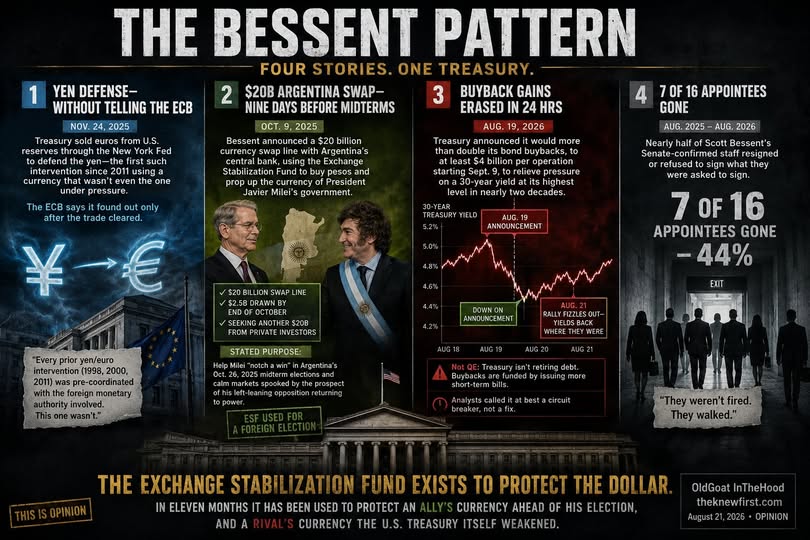
In eleven months Scott Bessent has defended the yen without telling the ECB first, wired a $20 billion swap line to an allied president nine days before that president's midterms, doubled Treasury's bond buybacks to fight a yield spike that came right back the next day, and watched nearly half his own Senate-confirmed staff walk out rather than sign what they were asked to sign. Four stories. One Treasury.
OldGoat InTheHood · theyknewfirst.com · August 21, 2026 · OPINION
7 OF 16 APPOINTEES GONE — 44%
$20B ARGENTINA SWAP, OCT. 9 2025
BUYBACK GAINS ERASED IN 24 HRS
THIS IS OPINION. Every date, dollar figure, and quoted official below is documented and labeled as such — see Confirmed Sources. That these four episodes belong to one pattern, rather than four unrelated stories about the same Treasury Secretary, is this Old Goat's read, flagged where it appears.
Start With What Was Already Reported
This dashboard has been tracking Bessent's yen intervention since the original piece ran three weeks ago: Treasury sold euros from U.S. reserves through the New York Fed to defend the yen, the first such intervention since 2011, using a currency that wasn't even the one under pressure -- and the ECB says it found out only after the trade cleared. Every prior yen/euro intervention this Old Goat could find precedent for (1998, 2000, 2011) was pre-coordinated with the foreign monetary authority involved. This one wasn't. That piece stood on its own. It doesn't anymore -- not once you put it next to the other three things Bessent has done since.
The Argentina Swap Came First
Before the yen, there was Argentina. On Oct. 9, 2025, Bessent announced a $20 billion currency swap line with Argentina's central bank, drawing on the Treasury's Exchange Stabilization Fund to buy pesos and prop up the currency of Javier Milei's government. By the end of October, Argentina's central bank had already drawn $2.5 billion against the line. Six days after the swap was announced, Bessent told reporters Treasury was separately trying to line up another $20 billion from private investors for Argentina -- on top of the public swap.
The stated purpose was not disguised. Coverage at the time was explicit: the goal was to help Milei, a political ally of the administration, "notch a win" in Argentina's Oct. 26, 2025 midterm elections and calm markets spooked by the prospect of his left-leaning opposition returning to power. That is a U.S. Treasury Secretary spending Exchange Stabilization Fund capacity -- built for defending the dollar -- to shore up a foreign election outcome nine days out.
The Exchange Stabilization Fund exists to protect the dollar. In eleven months it has been used to protect an ally's currency ahead of his election, and a rival's currency the U.S. Treasury itself weakened.
The Buyback That Didn't Survive a Day
On Aug. 19, 2026 -- the same day the national debt crossed $40 trillion, as this Old Goat covered separately -- Bessent announced Treasury would more than double its bond buybacks, to at least $4 billion per operation starting Sept. 9, specifically to relieve pressure on a 30-year yield sitting at its highest level in nearly two decades. It is not, technically, quantitative easing: Treasury isn't retiring debt, and the buybacks themselves have to be funded by issuing more short-term bills, which is its own kind of admission -- fighting a long-term borrowing-cost problem by borrowing more short-term.
It worked for about a day. The 30-year closed lower on the announcement, then within 24 to 48 hours the move had reversed -- CNBC's own headline by Aug. 21 read that the "bond buyback rally fizzles out," with longer-dated yields rising right back to where they'd been. Analysts quoted at the time called it at best a circuit breaker, not a fix. A Treasury Secretary spent real capacity to buy a day and a half of relief on the single largest number in the federal budget.
The People Who Wouldn't Sign
Here is the part that doesn't get the same headline treatment as currency swaps: seven of Treasury's sixteen Senate-confirmed appointees -- 44% -- have quit or been pushed out under Bessent, per the nonpartisan Partnership for Public Service, a turnover rate that dwarfs anything recorded under Bush, Obama, Biden, or Trump's first term. These aren't junior staff. John Hurley, the undersecretary for terrorism and financial intelligence and a Trump donor himself, stepped down over constitutional concerns about a crackdown on international payments out of Minneapolis. Ken Kies, an assistant Treasury secretary serving as acting IRS chief counsel, was pushed out for resisting political interference in audits. Billy Long, the Senate-confirmed IRS commissioner, was ousted for refusing to hand DHS private taxpayer records.
Mark Mazur, a former acting assistant secretary for tax policy who served under both parties, put the stakes in career terms: appointees who go along with directives that "go well beyond the norm" risk professional ruin, up to and including disbarment. People do not walk away from Senate-confirmed Treasury posts over policy disagreements. They walk away when what they're being asked to do is the kind of thing a lawyer can lose their license over.
Worth noting, adjacent and not the same fund: this dashboard separately covered the Justice Department's $1.776 billion "Judgment Fund" rescission in Nobody's Fund -- different agency, different official (Acting AG Todd Blanche, not Bessent), and this Old Goat is not claiming the two funds are the same instrument. What they share is the shape: a large, discretionary pool of federal money, run without the normal institutional guardrails, inside an administration where career appointees across at least two departments are now on record saying they were asked to do things that don't hold up.
Update · October 25, 2026 · How much room is left
REPORTED: In a new primer, Paul Krugman lists three ways the economy could fall into a long slump: stagflation, a "liquidity trap" if the AI investment boom collapses, and a debt crisis. He says he worries most about the second, because the Fed has "much less room to cut rates now" than after the dot-com bust. He is careful to call it "a menu of possibilities rather than a forecast." The Old Goat checked the numbers his argument rests on.
The Fed's room. DOCUMENTED: On Sept. 16 the Federal Open Market Committee raised its target range by a quarter point, to 3¾–4%, on a 12-0 vote. Fed → The effective rate was 3.88% on Oct. 22. The next decision comes Oct. 28, at the end of a two-day meeting. DOCUMENTED, Fed history: from 2001 to 2003 the Fed cut its target from 6.5% to 1%, a 5½-point cushion. INFERENCE: today's cushion before zero is under 4 points.
Inflation expectations. DOCUMENTED: The University of Michigan's final October survey puts long-run inflation expectations at 3.5%, up from 3.4% in September and above their 2024 range of 2.8% to 3.2%. Year-ahead expectations are 4.7%, against 3.4% in February before the Iran war. Its Oct. 23 special report, "Risks of Entrenchment," says the rise "suggests that consumers do not expect meaningful disinflation for the foreseeable future." Michigan → Bond markets tell a calmer story. DOCUMENTED, FRED: the 10-year breakeven inflation rate was 2.34% on Oct. 23, against 2.25% on Feb. 27. INFERENCE: households expect more inflation and bond traders barely do. Both numbers are real, and the gap between them matters. The next Michigan reading comes Nov. 6.
Prices. DOCUMENTED, BLS data via FRED: consumer prices in September were 3.7% higher than a year earlier, 2.6% excluding food and energy. October's numbers come out Nov. 10. FRED →
Who is exposed if AI spending stalls. REPORTED: Krugman cites an Apollo estimate that hyperscaler AI investment will run at 2.4% to 3.2% of GDP a year for several years, several times the 1990s tech wave. The Old Goat has not checked the Apollo figure. One exposure can be read from a filing. DOCUMENTED, from Oracle's proxy statements: Larry Ellison has pledged Oracle shares to secure personal loans.
| Proxy record date | Shares pledged | Share of his stake | Close that day | Pledged value |
|---|
| Sept. 19, 2025 | 346 million | 29.9% | $308.66 | ≈ $107 billion |
| Sept. 21, 2026 | 413 million | 35.7% | $148.56 | ≈ $61 billion |
| Oct. 23, 2026 (same 413 million) | | | $126.16 | ≈ $52 billion |
INFERENCE, the Old Goat's arithmetic from the proxy counts and closing prices: Ellison put up 67 million more shares as collateral while the value of all the pledged shares fell by roughly half. The proxy says the loans fund "outside personal business ventures" and that no shares are pledged in margin accounts. It does not name the ventures. 2026 proxy → 2025 proxy → The Old Goat tested whether these loans connect to the Ellison family's media deals in Superior Proposal. The record does not show that link. DOCUMENTED, added after a further check: the guarantee Ellison signed for the Warner Bros. purchase says pledges on his trust's assets were disclosed to WBD in writing, and bars any pledge that could impair his ability to pay. The deal closed Oct. 6. Details are in the Superior Proposal update.
REPORTED: The New York Times reported Sept. 18 that people who had discussed it with Trump said his attacks on AI safety warnings stem partly from worry that an AI slowdown could crash the market and bring on a recession. NYT → INFERENCE: the gains from the AI boom are private, while the cost of a bust would fall on the public, and the Fed now has less room to soften a bust than it had in 2001.
A newer risk. REPORTED: Krugman also points to Azeem Azhar's Oct. 23 essay "The internet's Wuhan moment," which argues that AI has turned small software flaws into serious openings for attackers. Azhar → REPORTED: In South Korea, Shinhan Bank disclosed Oct. 1 that data on about 25,000 customers had leaked; within days breaches were reported at seven financial institutions, and President Lee Jae Myung said AI models were believed to have been used in some of the attacks. Police assigned 28 cyberterrorism investigators. Bessent said on May 3 that U.S. banks were preparing for AI-driven attacks on accounts; asked whether Americans should worry, he said, "You should."
Still to come: Krugman's third rate primer, on a "deleveraging spiral," has not been published.
Ongoing Review
The Old Goat will revisit this dispatch from time to time to verify what's written here, and leaves it to the reader to draw their own conclusions from the information presented.
Behind the curtain, no wizard to find. Just a thunder organ, a wallet, and scaffolding left behind.
The noise is the point. The scaffolding is the story.
Confirmed Sources
- DOCUMENTED — Yen intervention, euro sale, ECB informed only after the trade: per this Old Goat's prior dispatch and Financial Times reporting, Aug. 2026.
- DOCUMENTED — Oct. 9, 2025: Bessent announced a $20 billion peso currency swap with Argentina's central bank via the Exchange Stabilization Fund; by end of October, Argentina had drawn $2.5 billion against it; Oct. 15, 2025, Bessent said Treasury was separately seeking an additional $20 billion in private financing for Argentina — per Congressional Research Service report R48780, Fortune (Oct. 2 and Oct. 9, 2025), Al Jazeera (Sept. 23, 2025).
- DOCUMENTED — Stated purpose tied to helping Milei's political allies notch a win in Argentina's Oct. 26, 2025 midterms and calm market fears of a leftist opposition win — per contemporaneous wire coverage of the swap.
- DOCUMENTED — Aug. 19, 2026: Treasury announced more than doubling bond buybacks to at least $4 billion per operation starting Sept. 9, aimed at a 30-year yield at its highest level in nearly two decades; not classified as QE since Treasury is not retiring debt and buybacks are funded by additional short-term bill issuance — per CNBC, "Bessent moves to curb Treasury yields, putting new pressure on Warsh's Fed," Aug. 19, 2026, and CNBC, "Treasury doubles debt buybacks as Bessent moves to steady bond market," Aug. 19, 2026.
- DOCUMENTED — 30-year yield reversed within roughly 24–48 hours of the buyback announcement, wiping out the initial decline — per CNBC, "Longer-dated Treasury yields rise as Bessent's bond buyback rally fizzles out," Aug. 21, 2026, and CNBC, "Treasury yields rebound, wiping out the decline following Bessent's intervention," Aug. 20, 2026.
- DOCUMENTED — Seven of sixteen Senate-confirmed Treasury appointees (44%) have quit or been pushed out, a turnover rate exceeding the Bush, Obama, Biden, and first Trump administrations, per the Partnership for Public Service; named departures include John Hurley (undersecretary for terrorism and financial intelligence), Ken Kies (assistant Treasury secretary/acting IRS chief counsel), and Billy Long (IRS commissioner) — per Raw Story, "Terrified Trump officials flee in 'dramatic exodus' as pressure builds to bend law," Aug. 19, 2026; NOTUS, "Nearly Half of Trump's Treasury Appointees Have Left," Aug. 2026; The New Republic, Aug. 19, 2026.
- DOCUMENTED — Mark Mazur (former acting assistant secretary for tax policy) on career/disbarment risk for appointees asked to go "well beyond the norm" — per the same reporting.
- DOCUMENTED — DOJ's $1.776 billion Judgment Fund, its rescission by Acting AG Todd Blanche, and its separateness from Treasury as an agency and instrument — per this Old Goat's prior dispatch, Nobody's Fund.
- INFERENCE — That the yen defense, the Argentina swap, the bond buyback, and the appointee exodus together describe one pattern of Treasury being operated for political effect over institutional fiscal stewardship is this Old Goat's synthesis of the above documented facts, not a claim made by Bessent, Treasury, or any cited official or outlet.