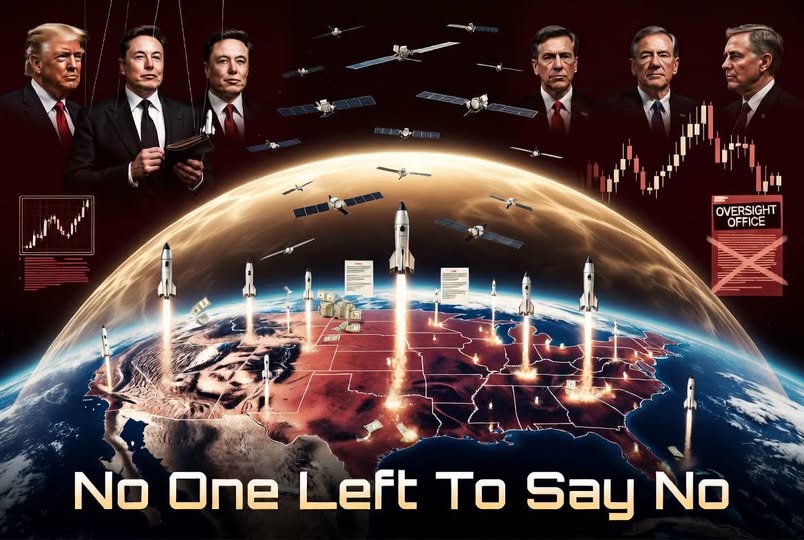
On May 20, 2025, in the Oval Office, Donald Trump announced a $175 billion missile shield that would ring the entire United States and be finished before he leaves office. Ten days earlier, few had heard the name "Golden Dome." Nine days after the announcement, forty-two members of Congress asked the Pentagon's Inspector General to look into how much control one company — and one man — was about to get over it. Nine days after that, the Pentagon's own independent testing office, the one whose job was to check whether any of this actually worked before the government paid for more of it, was gutted.
Twenty-five months of contracting later, that company holds more Golden Dome money than every other contractor in the program combined, its founder is the richest man who has ever lived, and the stock that made him a trillionaire is now down about ten percent from its first-day close. This is the architecture underneath that sentence — what is confirmed, what is pattern, and what has not been shown.
The Money
Golden Dome's funding runs through two separate legislative tracks that are routinely conflated in press coverage, so the dashboard keeps them apart.
Track one — the One Big Beautiful Bill Act (P.L. 119-21), signed July 4, 2025
Section 20003 of the reconciliation law appropriated $24.4 billion for "integrated air and missile defense," described by a joint House and Senate Armed Services Committee fact sheet as Golden Dome funding — though the underlying bill text never uses the name. Of that, $18.8 billion was for "next-gen missile defense tech," including $7.2 billion specifically for space-based sensors, plus $5.9 billion for layered homeland defense.
Track two — FY2026 defense appropriations, passed February 3, 2026
A separate ~$13.4 billion for Golden Dome-linked space and missile defense systems, on top of the OBBBA money. In March 2026, program director Gen. Michael Guetlein told the McAleese Defense Programs conference his office had been approved for an additional $10 billion "plus-up" specifically to accelerate three programs: airborne moving target indication (AMTI), the Hypersonic and Ballistic Tracking Space Sensor, and the Space Data Network — bringing the stated "objective architecture" total to $185 billion. Two months later, SpaceX won the two largest contracts issued under exactly those three program names. Orbit →
What the whole thing is projected to cost
This is the range the administration does not like to see printed in one place: $175 billion (White House), $185 billion (Guetlein's "objective architecture"), $524 billion (an earlier CBO estimate), $1.2 trillion (CBO, May 12, 2026), and $3.6 trillion (AEI). The spread is not noise. It is mostly one variable: how many space-based interceptor satellites the final architecture needs, and how often a fleet in low orbit — with a roughly five-year service life — has to be replaced. CBO's $1.2 trillion figure assumes 7,800 interceptors in orbit at any time and nearly 30,000 total launched over 20 years to sustain that number against orbital decay.
The Referee Resigns
Two things happened within nine days of each other in late May 2025, and the dashboard keeps them sequenced rather than merged, because the sourcing for each is distinct.
- May 2025 — forty-two members of Congress sent a formal letter asking the DoD Inspector General to review Elon Musk's involvement in Golden Dome, citing departures from standard acquisition process and a proposed "subscription model" that could give Musk "undue influence over national security."
- May 30, 2025 — CNN reported that Defense Secretary Pete Hegseth had gutted the Pentagon office responsible for independently testing Golden Dome before deployment — the Director of Operational Test and Evaluation.
Read separately, one is a congressional oversight request that produced no public findings this dashboard has located, and the other is a management decision inside the Pentagon attributed on the record to the Defense Secretary. Read together, the practical effect is the same either way: the two bodies with a formal mandate to check the program's largest contractor from the outside — an Inspector General review and an independent operational tester — were respectively unresolved and disabled within the same nine-day window that the company in question became the leading contender to build the thing being tested.
The Revolving Door
Michael D. Griffin — Griffin's relationship with Musk predates SpaceX itself: in 2002 the two men traveled to Russia together to try to buy refurbished ICBMs for a Mars mission; the deal fell through on the flight home, and Musk decided to build his own rocket company instead. Griffin later became NASA Administrator (2005–2009), where the agency's Commercial Orbital Transportation Services program — which Musk has credited with saving SpaceX from bankruptcy — directed a combined $3.5 billion in contracts to SpaceX and Orbital Sciences. In 2018, as Under Secretary of Defense for Research and Engineering, Griffin created the Space Development Agency, whose Proliferated Warfighter Space Architecture is the direct institutional ancestor of Golden Dome's space layer. He currently advises Castelion, a hypersonic-weapons startup founded by former SpaceX executives.
Terrence J. O'Shaughnessy — A retired Air Force four-star general who commanded both U.S. Northern Command and NORAD — the officer historically responsible for detecting and defending against exactly the threats Golden Dome is designed to intercept. In August 2019, while still in uniform, he told a defense conference that Starlink's early satellite clusters had "completely changed" the ability to sense threats against the United States from space. He left government and joined SpaceX in 2021, where he now leads government programs and has held a senior role on Starshield, the company's military satellite division. He is credited with proposing the SHIELD missile defense concept that fed into Golden Dome's design.
Neither man's current position is illegal or, on the available record, undisclosed. The pattern worth naming plainly: the agency that defined the requirement, the general who ran the command the system replaces, and the founder of the program's largest contractor are three points connected by two individual career paths, not three independent institutions checking each other.
The Contracts
SpaceX's confirmed Golden Dome-linked awards to date: Oct 31, 2025 — $2.0 billion (600-satellite constellation); Apr 2026 — $57 million (Link-182, carried from prior research, not independently re-verified this session); May 26, 2026 — $2.29 billion (Space Data Network Backbone); May 29, 2026 — $4.16 billion (SB-AMTI). Total roughly $8.5 billion.
SpaceNews reported the two May 2026 awards alone — $6.45 billion in four days — exceed the combined prototype contracts issued to every other Golden Dome vendor in the program, including Anduril, Lockheed Martin, Northrop Grumman, Raytheon, and True Anomaly. The same reporting noted that funding originally earmarked for the Space Development Agency's multi-vendor Transport Layer — which had split business across roughly 300 satellites among several companies — was redirected into the new Space Data Network program that SpaceX won outright, a shift industry sources described as concentrating a program that was designed to be distributed. Suspects →
The IPO
On June 12, 2026, SpaceX went public on the Nasdaq under the ticker SPCX — the largest initial public offering in history. This resolves a data-quality flag that has sat on the dashboard since the filing: the $1.77T / $2.18T / $2.5T figures in circulation were not competing estimates of the same number — they were different moments in the same six-week window: $1.77T (S-1 target price, June 3), roughly $2.1T (Day 1 close, June 12, +19.2%), roughly $1.9T (July 10).
A few details from the offering are worth carrying forward. In February 2026, SpaceX absorbed Musk's AI company xAI in a merger valuing xAI at $125 billion against a $1 trillion SpaceX — folding Grok and the Colossus data-center buildout directly into the same balance sheet now holding the Golden Dome contracts. Musk retained roughly 42% of shares but 82% of voting power through a super-voting share class; insiders agreed to a 366-day lockup. Sen. Elizabeth Warren sent a twelve-page letter to the SEC before pricing, arguing the governance structure left ordinary shareholders with "significantly fewer rights than those traditionally offered," a request the SEC did not act on to delay the listing. Tesla disclosed it holds 18.99 million SpaceX shares — worth roughly $2.56 billion at the IPO price — first revealed in the S-1. (An earlier claim that the stake traced to a $24.28 million Musk purchase 352 days before the offering was retracted July 1, 2026: no supporting Form 4 exists, and the dispatch built on it, "The Purchase," was retracted with it. The stake itself is real and S-1-documented.) The two dispatches share a data point and should cross-reference each other when both are live.
Reading: "Feud As Theater"
The following is the author's editorial interpretation of a publicly documented sequence. It is not a claim of intent, coordination, or private communication between any of the parties named, and it should be weighed as inference, not fact.
The theory: the June 2025 feud was never a rupture in the relationship, but cover for it — a public falling-out staged (or at minimum, allowed to be read that way) at the exact moment Congress and the press were asking pointed questions about a defense secretary gutting oversight of his biggest missile-shield contractor. The feud gave both men a public reason to distance themselves from each other's decisions. Six weeks later, the funding it would have been politically awkward to protect passed intact. Four months after that, the contracts began. This is timeline-consistent. It is not proof of coordination, and no source cited in this dispatch claims otherwise.
The Old Goat will revisit this dispatch from time to time to verify what's written here, and leaves it to the reader to draw their own conclusions from the information presented.