Anthropic priced its initial public offering Wednesday at $83 a share, above the range it had marketed. Counting every share that could exist, that values the company at about $1.5 trillion. Counting only shares already outstanding, it is closer to $1 trillion. The stock starts trading Thursday on Nasdaq under the ticker ANT, after a sale of about 980 million shares that raised more than $81 billion, the largest IPO on record.
The prospectus talks about curing disease and an age of miracles. The corporate structure underneath it is one the Associated Press described as uncharted territory for a company worth potentially trillions. "I don't know if I can really compare it to anything else," Douglas Chia, a senior fellow at Rutgers Law School who advises companies on corporate governance, told The New York Times.
That last part should stop everyone cold.
A Trust With Real Power, on a Short Leash
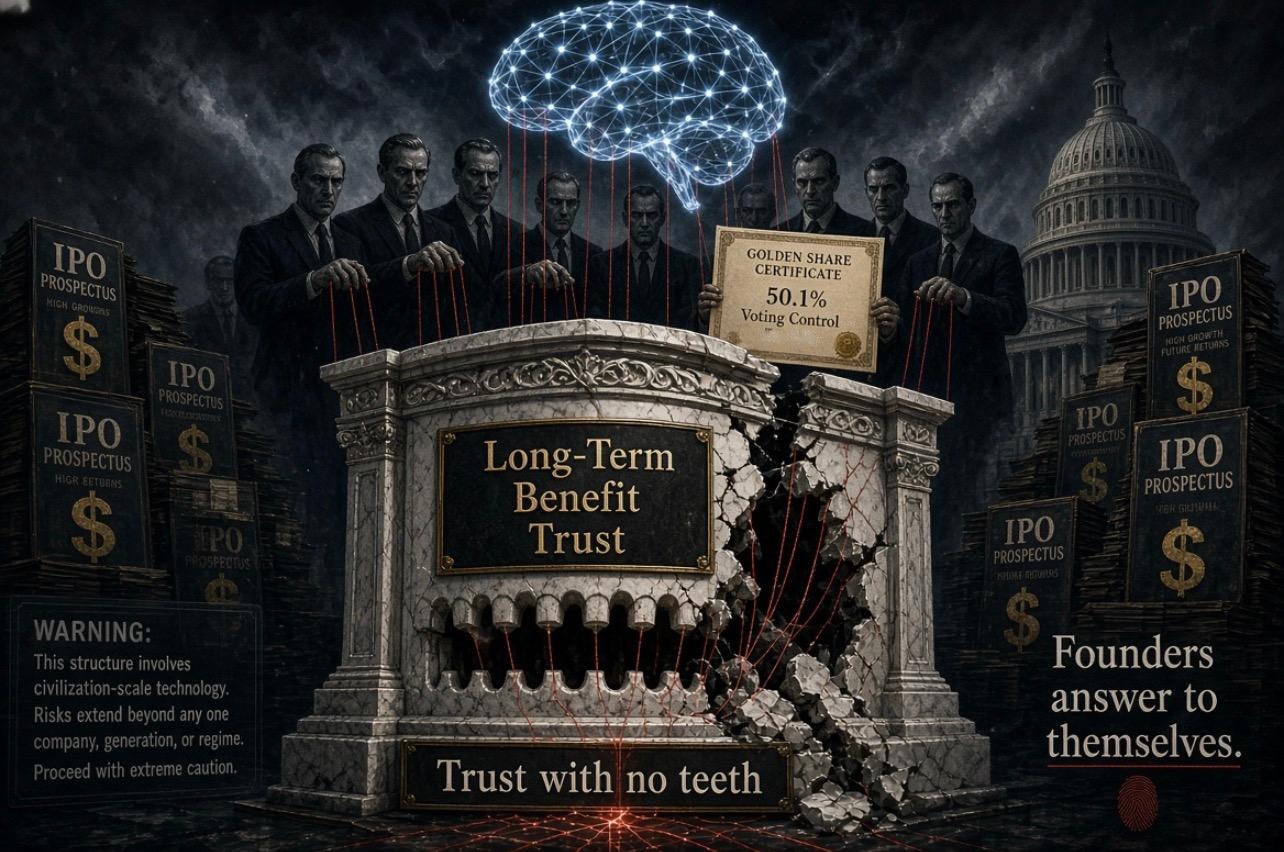
Credit where it is due, because readers will check. Anthropic set up its Long-Term Benefit Trust in 2023, staffed with trustees who hold no financial stake in the company. Under the IPO structure the trust holds a single Class T share, and that share lets it elect four of Anthropic's seven directors. That is a board majority. Most corporate promises about the public good never get anything close to that.
Now the leash. In the months before the offering, The New York Times reported from securities filings, the company created a new class of shares for its founders: a single Class F share, held by an entity called Founder LLC whose only members are the seven co-founders. That share carries no economic rights and 50.1% of the shareholder vote on general matters. The founders elect the other three directors. In the prospectus's own words, people buying Class A stock in this offering "generally will not be able to affect the outcome of any matter" put to stockholders.
The trust's majority has a soft spot, too. One of its four seats, the one that can break a tie, can't be filled or emptied without the consent of the board's nominating committee, which the AP reports is expected to be founder-controlled. When the committee and the trust disagree, the question goes to a vote of employee shareholders. Berkeley law professor Stavros Gadinis told the AP the trust "cannot determine the everyday decisions of these directors or the management of the company." Reporting on the structure in June said a large enough supermajority of stockholders can rewrite or end the trust altogether.
Harvard law professor Jesse Fried, who has studied Anthropic's structure, told The New York Times that a founder-controlled board committee can help overrule one of the trust's four appointments. The trust's authority was "watered down" by the changes, he said, though they don't "fundamentally change the governance of the company." Back in June he had put the balance this way: "the guardians have some power and they use it to push things in a certain direction, but they can't go too far."
Translate that out of lawyer-speak. The trust picks the board. The founders own the vote. When the two disagree about the tie-breaking seat, the employees decide. Nobody in that chain is the public that just bought in.
Not for Life, but Close Enough to Matter
The founders' letter says their voting power "is not permanent." It passes to common stockholders "once fewer than three of us remain in the voting entity." That is a real off-switch, and it should be reported fairly.
It is also not a date. There is no seven-year sunset of the kind large pension investors push for. Reporting on the filing found that a co-founder keeps a seat in Founder LLC while holding as little as 2% of their IPO-era stock. The prospectus itself warns that as the founders give their shares away, "their voting control through the Founder LLC will remain unchanged." The founders have pledged to give away 80% of their wealth, and the company has pledged at least 5% of its stock to a public-benefit fund; both pledges are generous. Each one, as it is fulfilled, widens the gap between what the founders own and what they control.
We've Seen This Movie
The Old Goat didn't trust SpaceX's governance when Musk took that company public this year. Ten-vote Class B shares. A Class B right to elect 51% of the board for as long as a single share remains. Reincorporation in Texas. A mandatory arbitration bylaw. Orbit →
The Council of Institutional Investors, whose members manage about $5.2 trillion in retirement money, wrote to SpaceX on June 9. The letter, signed by deputy director Glenn Davis, said buyers of Class A stock "would have little or no voice in the governance of the Company." Its core sentence: "Our concern is with accountability to shareholders who provide the company capital."
That letter was about SpaceX. On Anthropic, Davis, now the council's executive director, told The New York Times the group will "wait and see" how the structure plays out. His read of the founders' voting power was blunter: "ultimately the founders are accountable to themselves," rather than to shareholders. Anthropic's structure is not Musk's: the founders hold far less of the vote than Musk does, and SpaceX has nothing like the trust. The two companies still arrive at the same place on the one question CII asks, which is whether the people supplying the capital can hold anyone accountable.
New York City Comptroller Mark Levine did write to Anthropic, on Oct. 14, asking it to delay the offering: "Before going public, the company should prioritize addressing the myriad safety concerns surrounding AI threats." Anthropic went ahead.
The dressing matters. SpaceX never pretended to be anything other than a rocket company run by its founder. Anthropic is asking the public to trust a company whose own filing says advanced AI could "pose catastrophic or existential risks to humanity," and whose CEO has put the chance that AI goes "really, really badly" at 25%. Meanwhile public money now sits behind about $895.4 billion in obligations for chips, computing power and other infrastructure, running through 2045 by a New York Times tally of the deals in the prospectus, with roughly half due before the end of 2030.
The Part That Belongs in Front of Congress
The filing discloses a fight with the government that ought to get more attention than it has. In February, Anthropic refused the Pentagon's demand that Claude be available for "all lawful uses." The company would not drop its prohibitions on lethal autonomous warfare and mass surveillance of Americans. President Trump ordered federal agencies to stop using Anthropic's technology. By a letter dated March 4 and effective March 5, Defense Secretary Pete Hegseth designated Anthropic a supply chain risk. Reporting at the time called it unprecedented for an American company; the label had been used against firms from adversary countries, such as Huawei. Anthropic lost a Pentagon contract worth up to $200 million. The Carveout →
The courts have split. On Sept. 25 a D.C. Circuit panel upheld the designation 2-1. Judge Gregory Katsas wrote that the statute "turns on what Anthropic does, not why Anthropic does it." Judge Karen LeCraft Henderson dissented, warning that the reading would let the government call nearly any limit a vendor sets a supply chain risk. All three judges rejected Anthropic's claim that it was punished for its speech; they found no causal link. A federal court in California ruled the other way under a separate statute. Anthropic has asked the full D.C. Circuit to rehear the case.
"Retaliation" is Anthropic's word, and so far no appeals court has accepted it. The sequence is still on the record: the company said no in February, and the label arrived days later. Readers can weigh that for themselves.
It also cuts in Anthropic's favor. A company that walked away from a nine-figure Pentagon contract rather than drop its limits on autonomous weapons and domestic surveillance has shown that its safety talk is more than talk. The Old Goat says so plainly.
Now ask who holds the leverage the next time Anthropic needs something from Washington that money alone can't buy: a ruling, a contract, a regulatory carve-out. The government has already shown what it will do to a vendor that says no. On the other side of the table sits a board that answers to seven founders and to a trust that cannot direct management, holding technology the Pentagon has openly said it wants without restrictions. That arrangement should be the subject of hearings, not just of financial press coverage.
"Something Greater" Is Not a Governance Structure
The founders' letter asks investors "not to think of your purchase in purely transactional terms," and to see it as "an opportunity to be part of something greater." That is not the language of a normal S-1. It is the language of a mission that has outgrown the governance built to hold it, phrased nobly enough that questioning it feels almost rude.
The Old Goat is not questioning whether Dario Amodei believes what he says about safety. His company runs a research program on whether its own models might deserve moral consideration, and it gave them the ability to end abusive conversations as a welfare measure. Nobody cynical spends money on that.
Belief is not a governance structure, though. Good intentions don't need congressional oversight. Concentrated, unaccountable control over a technology its own builders put at a one-in-four chance of going really, really badly does, no matter who holds the wheel and no matter how sincerely they mean well while they hold it.
Fried doubts anyone will copy the model soon: "If Anthropic works for 10 or 15 years, maybe somebody will use a structure like that again." That is the point. If it works on Wall Street, it becomes the template. Congress should not wait 10 or 15 years to decide whether this is how the most consequential technology in history gets governed.
Congress has spent the year distracted by war, by China and by the next election. This is the story that should get its attention. Anthropic is not uniquely villainous. The problem is the structure itself: a template for building the most dangerous technology in history beyond the reach of the people it will be used on.