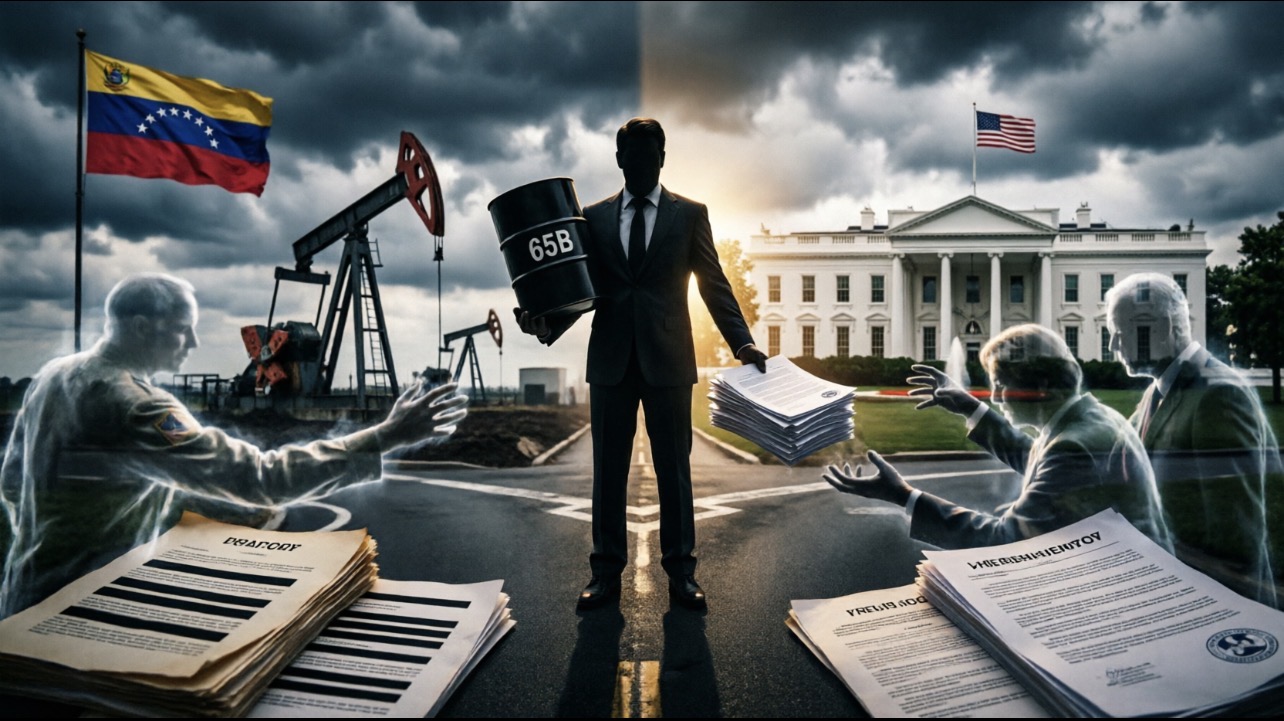
I. Two Phone Calls
In the early hours of Saturday, January 3, 2026, American special-operations forces pulled Nicolás Maduro and his wife out of Venezuela and put them on a flight to New York, where Maduro faces narco-terrorism charges he still disputes. Venezuela's Supreme Tribunal — a court both his allies and his critics describe as stacked for years with Maduro loyalists — moved the same day, ordering Vice President Delcy Rodríguez to assume the presidency "to guarantee administrative continuity."
Rodríguez did not, in that moment, sound like a woman about to sign the largest oil deal in American history with the government that had just deposed her boss. Sworn in two days later, she told the National Assembly she came "in pain over the kidnapping of our heroes" and called the operation an illegal, illegitimate abduction.
But before Secretary of State Marco Rubio's call reached her, another one already had. Alejandro Betancourt — a 46-year-old Venezuelan oil trader who at that exact moment was fighting extradition from London on a Swiss money-laundering warrant — was on the phone with Rodríguez in those same predawn hours, according to people familiar with the discussions, walking her toward Washington before Washington's own top diplomat got through. By the time U.S. officials did reach her, they had already settled on who would run point on the ground.
He spoke directly with Rodríguez, soon to be anointed interim president, even before Secretary of State Rubio reached her about the U.S. — Washington Post, Aug. 27, 2026
Eight months and one very large equity stake later, that decision is the throughline of everything that follows.
II. The Deal
On Friday, August 28, the White House announced what President Trump called "the biggest oil deal in world history": a joint venture giving the United States effective control over 65 billion barrels of Venezuelan crude — more than the entire proven oil reserves of the United States itself, which stood at roughly 46 billion barrels at the end of 2024. The vehicle is North American Blue Energy Partners, or NABEP, a private firm founded in April 2024 and run by Betancourt, to which Venezuela's interim government granted 100-year concessions over 17 oil fields — fields the White House itself noted were previously controlled by Russian or Chinese interests, or by associates of Maduro and Hugo Chávez.
The mechanics, laid out in a White House fact sheet three days later on August 31: the Pentagon's Office of Strategic Capital gets a 35 percent stake in NABEP through "penny warrants" — the right to buy shares for a fraction of a cent apiece — at no upfront cost to taxpayers; the State Department gets the right to buy 20 percent of NABEP's output at cost, plus first refusal on the remaining 80 percent; Washington gets veto power over NABEP's board, a majority of whom must be U.S. citizens; and NABEP commits to $100 billion in new infrastructure investment and up to $200 billion in tax and royalty payments to Venezuela over 25 years.
Almost none of those numbers survive contact with each other. Rodríguez told her own legislature the concession runs 25 years; the White House says 100 — both claims stand uncorrected as of this writing. The 65-billion-barrel figure is a resource-in-place estimate, not an audited, bankable reserve booked the way SEC rules require of a public company.
And two days before the deal went public, Pentagon spokesman Sean Parnell told Reuters on the record that "the Office of Strategic Capital does not take equity stakes in private companies" — a flat denial of the exact structure the White House confirmed in writing three days later. Congress, Semafor reported the following week, had already told that Pentagon office in years past that it has no legal authority to acquire equity stakes at all. No one in the administration has reconciled any of it, and no contract text has been made public.
III. The Man In The Middle
Betancourt is not an oil executive who happened to be in the right place. He built his fortune inside the Venezuelan state he now says he is helping to rebuild. His firm, Derwick Associates, won contracts to build power plants for Hugo Chávez's government after a drought-driven electricity crisis in the late 2000s, when Betancourt was still in his twenties — contracts a Spanish anti-corruption complaint and other reporting describe as marked by bribery, cost overruns and influence-peddling inside the state oil company, PDVSA, allegations Betancourt denies. In the 2010s he bought into Petrozamora, an oil venture co-owned by the Venezuelan state and Russian investors — one of the very fields now folded into NABEP under U.S. control.
He fell out with Maduro in 2020 after backing U.S.-recognized opposition figure Juan Guaidó, reportedly helping finance the opposition and acting as a go-between with Venezuelan military officers; Maduro's government responded by ordering his arrest, freezing his domestic assets, and sending security forces to his properties. That history is presumably part of why this administration considers him rehabilitated. It has not stopped prosecutors elsewhere.
Betancourt was arrested in London twice in 2025 — first in September on a Spanish warrant, then in November at Switzerland's request — and spent months barred from leaving the U.K. while authorities weighed extraditing him to Zurich. In Spain, a Madrid court dismissed a money-laundering case against him in March 2026, only for its own criminal chamber to reopen the case in June, calling the dismissal premature and citing an alleged fraud scheme worth roughly $4.85 billion. He has never been charged in the United States, Switzerland, Spain, or Venezuela, and denies wrongdoing everywhere the question has come up.
None of that stopped Washington from clearing his path. Deputy Secretary of State Christopher Landau contacted Swiss authorities about Betancourt in January; then-Attorney General Pam Bondi personally raised the case with her Swiss counterpart in February; then-Deputy Attorney General Todd Blanche joined a call with Swiss prosecutors in March. Federal prosecutors in Miami, who had spent a decade investigating Betancourt's alleged role in a billion-dollar PDVSA money-laundering scheme, quietly closed their case in the months that followed, on instructions from Blanche's office, according to two people briefed on the matter — an account the Justice Department calls "a complete fabrication." Switzerland's own arrest warrant has simply gone unenforced.
Mauricio Claver-Carone, at the time still the administration's unofficial point man on Venezuela, would later describe Betancourt as an "important ally" for the United States.
IV. The Man He Replaced
Betancourt did not build NABEP alone. He co-founded it in April 2024 with Harry Sargeant III, a Florida asphalt magnate, Republican mega-donor and former Marine pilot who had spent nearly four decades cultivating access on both sides of the U.S.-Venezuela relationship — access valuable enough that Maduro reportedly called him "abuelo," grandfather. Sargeant held his stake through an offshore vehicle, Bluewave Properties; Betancourt ran the company.
By one account from an associate of Betancourt's, it was Sargeant who first put Betancourt in front of Trump's orbit — introducing Washington to the man who would go on to replace him.
If true, the introduction cost him his seat at the table. On August 7, Sargeant signed a $300 million deal to sell Bluewave to a buyer connected to Betancourt — around the same time, people familiar with the matter say, that the Treasury Department both froze Bluewave's assets over Maduro-era sanctions violations and quietly issued the license that let Sargeant sell. Treasury didn't formally add Bluewave to its sanctions list until August 18 — eleven days after the money had already changed hands.
A Republican donor and decades-long back-channel operator was pressured out within weeks, using the same legal instrument built to punish Maduro's enablers; his partner and eventual buyer walked into the biggest Venezuela deal in history three weeks later.
V. No Bid, Anywhere
Follow any thread in this deal back far enough and it runs through a process with no competition in it.
Start with the debt. Mauricio Claver-Carone — a former Trump special envoy turned "private citizen" who kept running Venezuela policy informally while operating his own undisclosed private-equity fund — steered a contract worth more than $150 million to Centerview Partners to restructure roughly $200 billion of Venezuelan debt, with no competitive bidding process; several major sovereign-restructuring firms were never invited to compete for the work. Claver-Carone says neither he nor his fund holds any Venezuela stake; the fund's name, investors, and strategy remain undisclosed, and the claim is untested. He left the informal role in late July, calling it voluntary; multiple sources told Reuters he was pushed out after former Venezuela envoy Richard Grenell complained directly to Trump about his business dealings.
Then the equity itself: the Pentagon acquired its 35 percent NABEP stake through an office that had just told a reporter, on the record, that it doesn't do that — and that Congress had already told it, in writing, that it isn't allowed to. (Section II.)
Then the invitations. When Trump summoned oil executives to the White House on January 9 to discuss Venezuela, the guest list included the expected majors — Chevron, ExxonMobil, ConocoPhillips — alongside a cluster of smaller, less experienced firms clustered improbably around one city: Denver. Raisa Energy (Venezuelan-led, backed by Citadel and Ares Management), Tallgrass Energy, and Aspect Holdings — which lists former House Speaker Kevin McCarthy as an independent director — are all headquartered there, the same city Energy Secretary Chris Wright calls home. Colorado is a minor oil hub by national standards; coverage of the meeting noted the region produced roughly a tenth of the crude Texas and New Mexico did that same month. Nothing proves the invitations were personal favors. Nothing about the invitees' scale explains why they were in the room instead of firms with deeper Venezuela experience, either.
Then the oil itself. Vitol, the world's largest independent trading house, got into the Venezuelan market through Betancourt himself, who arranged what the Washington Post describes as an opaque deal letting Vitol and Trafigura buy Venezuelan crude at a prepaid $15-a-barrel discount, before Rodríguez had been in office a week. Days later, at the January 9 White House meeting, Vitol trader John Addison — who had personally donated $6 million to Trump's 2024 campaign, including $5 million to MAGA IncDonors → — told the president Vitol would use its "influence over the Venezuelans" to get the U.S. its price.
"...the influence you have over the Venezuelans will ensure that you get what you want." — John Addison to President Trump, Jan. 9, 2026, per the Financial Times
Vitol got the first American-brokered sale of seized Venezuelan crude, roughly $250 million, with Trafigura picking up a matching cargo; a Department of Energy official said the two were chosen because they were "willing and able to move" fastRelated →. Vitol says Addison's donations were personal and unconnected to company business; the White House says the president always acts in Americans' best interest. Neither denial addresses what came next: by August, OFAC had converted that first sale into a long-term exclusive license naming Vitol and Trafigura the sole authorized buyers and marketers of Venezuelan crude through June 2027 — a two-firm arrangement awarded, again, with no competitive tender. House Oversight Democrats and a group of fourteen senators have both demanded financial-disclosure answers from the administration; as of this writing, neither has gotten one.
VI. The Ones Who Were Already Positioned
Not every windfall required a new deal. Some were just waiting for the politics to catch up.
Paul Singer's Elliott Investment Management, through its subsidiary Amber Energy, won a court-ordered auction for Citgo — Venezuela's U.S.-based refining arm — for $5.9 billion at the end of November 2025, five weeks before Maduro's capture, in a sale forced by creditors after Venezuela's bond defaults. Singer, a longtime Trump donor whose public reconciliation with the president dates to 2017, was already positioned; the regime change simply removed the political risk hanging over an asset he had already agreed to buy.
Kentucky Republican Thomas Massie, no ally of Elliott's, called it out from the right, posting that Singer — a major donor who had separately spent heavily trying to defeat Massie himself — stood to gain handsomely once the administration took over the country whose distressed assets he had bought. ConocoPhillips, holding more than half of the roughly $20 billion in creditor claims against Citgo, stands to benefit on the same terms.
VII. Whose Government, Exactly
Every one of these arrangements depends on the signature of one government. It is worth asking what that signature is actually worth.
Rodríguez served as Maduro's vice president since 2018 and personally drew U.S. sanctions during Trump's first term for what Treasury called undermining Venezuelan democracy. For the first two months of her presidency she simultaneously held the oil portfolio herself, as Maduro's holdover Minister of Petroleum and Hydrocarbons — the same ministry now signing away 65 billion barrels to a private company.
A Wall Street Journal report citing a classified U.S. intelligence assessment found American officials settled on her specifically because internationally recognized opposition figures — 2025 Nobel Peace Prize laureate María Corina Machado and 2024 opposition candidate Edmundo González among them — were judged unable to consolidate legitimacy fast enough. Washington didn't install a democratic alternative to Chavismo. It chose the Chavista official already in the building.
Rodríguez's brother, National Assembly President Jorge Rodríguez, told the conservative U.S. outlet Newsmax in February that no election was coming "in this immediate period." By early July, Venezuela's own 1999 constitution had run out its clock: the document caps a temporary presidential vacancy at 180 days before elections must follow, and that deadline passed with no vote scheduled, according to the Congressional Research Service. As recently as September 2, one week before the deal's own fact sheet was published, Rodríguez was still declining to name a date, telling reporters only that a vote would come "when Venezuela is ready."
Venezuela's Supreme Tribunal — the court that installed her — never resolved whether her presidency is temporary or permanent in the first place, which may be the more useful fact than any deadline: without that classification, no election clock unambiguously starts. A follow-up ruling in April again avoided the question, preserving what one legal analysis of the transition called ongoing uncertainty, from a court still widely described as aligned with Maduro's own appointees.
Layered on top of the political question is a narrower legal one, raised by the Center for Strategic and International Studies: under Venezuela's own Organic Hydrocarbons Law, reformed in January 2026, PDVSA may grant private firms only limited "production participation contracts" — not the hundred-year concessions this deal claims, and not any transfer of rights over the oil deposits themselves. By its own government's law, Venezuela may not have had the authority to sign the deal it signed. A Venezuelan oil-industry executive made a version of the same argument to the New York Times: the constitution reserves hydrocarbon rights to the state through PDVSA alone, meaning the arrangement may rest on no valid legal basis at all.
VIII. What The Deal Is Actually Worth
Strip away the announcement and the numbers get considerably less impressive. The 65 billion barrels is a geological estimate of oil in the ground, not proven, extractable, bankable reserves; recovery costs and infrastructure gaps remain unresolved variables that determine how much of it is ever economically recoverable at all. Rystad Energy puts the real investment bill at more than $183 billion over more than a decade just to lift Venezuela's national output to 3 million barrels a day — nearly double NABEP's own $100 billion pledge, for a national target NABEP alone isn't claiming to deliver.
Peter Harrell, a Biden-era National Security Council economics advisor, put the administration's larger pattern plainly: on this deal as on its other recent equity stakes, it hasn't laid out any legal rationale for how it believes it can do this.
Trump has promised the deal will bring down gas prices. Asked directly about timing, he allowed relief "could be a little bit" away, then waved off analyst predictions that it could take years by noting that even two years would still be a short wait — an unusually candid admission, for him, that nothing changes soon. Exxon's own CEO calls Venezuela currently "uninvestable."
Chevron and Italy's Eni, the two major companies that also signed new Venezuela agreements that same week, did it the old-fashioned way: Chevron committing $7 billion through 2031 for a defined production target under its own operational controlSuspects →, and Eni taking a specific 25-year field concession — ordinary oil-industry contracts, with no Pentagon equity, no penny warrants, and no need for the Justice Department to place any calls to Zurich.
The contrast is the whole story. When American and European companies with decades of Venezuela experience want in, they negotiate a contract. When Washington wanted this deal, it needed a person — a specific one, already inside the room, whose case files it then had to go make disappear.