I. The Meeting And The Proclamation
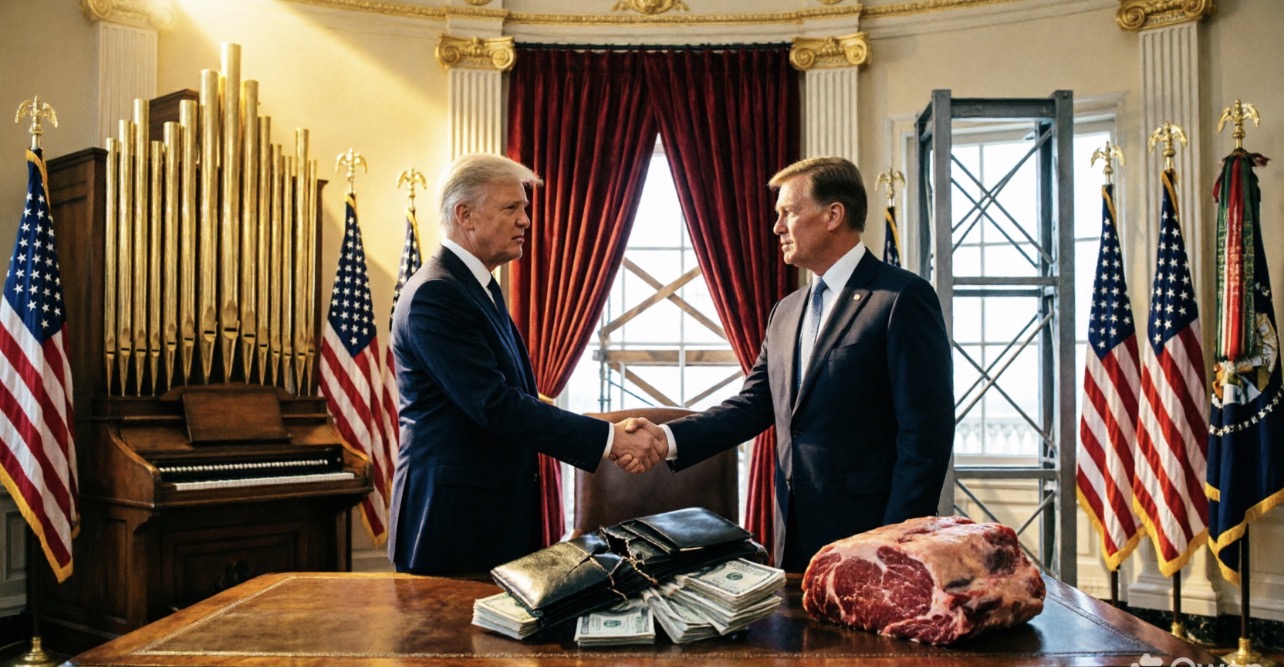
On August 20, Joesley Batista — the Brazilian billionaire who co-controls JBS, the world's largest meatpacker — met privately with President Trump in the Oval Office. According to the Wall Street Journal, citing people familiar with the meeting, Batista argued that opening the U.S. market to more Brazilian beef could bring down American prices; Reuters later reported the same account but said it could not independently verify the details. It could not be determined who arranged the meeting.
The next day, Trump announced a 90-day plan allowing up to 300,000 metric tons of foreign lean beef trimmings — about 660 million pounds, roughly 2 percent of annual U.S. beef consumption — into the country without the usual 26 percent out-of-quota tariff, on a first-come, first-served basis of up to 100,000 metric tons a month. The White House said the beef would sell at roughly 25 percent below prevailing prices. The proclamation did not name a country. Brazil, the world's largest beef exporter, was positioned to supply most of it.
There is a real crisis behind the announcement. The U.S. cattle herd has shrunk to its smallest size in 75 years, a supply crunch driven by drought, high feed costs, herd liquidation, and a separate ban on Mexican cattle imports tied to a screwworm outbreak; rebuilding a herd takes a minimum of two years once ranchers start holding back heifers to breed rather than sell. Trump framed the move as help for ranchers as much as consumers, and signed companion orders letting ranchers process and sell their own meat and requiring country-of-origin labeling on foreign beef. None of that required the specific beneficiary to be a company that had, seven months earlier, become the largest single corporate donor to his inauguration.
II. The Company
Joesley Batista and his brother Wesley are board members and major shareholders of JBSSuspects →. In 2017, both brothers admitted to bribing roughly 1,800 Brazilian officials and served time in custody as a result. In 2020, during Trump's first term, the SEC and Justice Department fined JBS, its parent J&F Investimentos, and the Batistas more than $250 million for violating the Foreign Corrupt Practices Act — a bribery scheme that funded JBS's U.S. expansion, including its acquisition of the poultry giant Pilgrim's Pride. The SEC called the Batistas' conduct a "profound failure" of corporate governance. JBS says it has since built out internal compliance controls.
That record was enough to keep JBS off the New York Stock Exchange for close to a decade, through a nearly two-year SEC delay on its most recent attempt, opposed throughout by environmental groups over Amazon deforestation and by congressional Democrats over the corruption history.
III. The Fast Track
In February 2025, weeks into the new administration, the Justice Department announced it would pause enforcement of the Foreign Corrupt Practices Act generally — the same law JBS had been fined under. It was not a JBS-specific action, but JBS was one of the highest-profile companies with an open history under that law.
Around the same time, Pilgrim's Pride — JBS's U.S. subsidiary — gave $5 million to Trump's inaugural committee, more than Meta, Amazon, Apple, and Google's CEO combined, and the single largest corporate donation to the eventDonors →. A Federal Election Commission filing made the contribution public in the second half of April 2025. On April 22 — a Tuesday, and within days of that disclosure — the SEC declared JBS's stock-listing registration effective, over the objections of environmental groups and congressional Democrats, the approval that actually cleared its path to Wall Street.
Your large donations and direct stake in federal policies and enforcement actions... raise serious concerns about a potential quid-pro-quo arrangement. — Sen. Elizabeth Warren, letter to Pilgrim's Pride and JBS USA, May 19, 2025
Warren's letter, sent to Pilgrim's Pride CEO Fabio Sandri and JBS USA CEO Wesley Batista Filho, noted the companies were simultaneously subject to several ongoing federal investigations. JBS did not respond to press inquiries about the letter; the company later told the New York Times the inauguration donation was "entirely unrelated" to a listing process that required full compliance with SEC rules.
Shareholders approved the transaction May 23; the NYSE cleared the listing June 5; JBS N.V. shares began trading in New York on June 12, 2025 — six months after the donation, roughly ninety days after the SEC approval that made it possible, and after JBS's first-quarter lobbying spend had already doubled year over year to more than $500,000.
IV. Who Pays For It
The regulatory tailwind didn't stop at the listing. In the months after the inauguration, the USDA moved to permanently raise poultry processing line speeds and withdrew a proposed rule that would have strengthened Salmonella testing — both changes the poultry industry had sought for years, both opposed by worker-safety and public-health advocates. Meatpacking is already among the most hazardous work in the country; advocates describe the speed increases as making it more dangerous, not less.
On the beef side, the European Union moved separately to halt Brazilian beef imports over noncompliance with its antibiotic-use standards — leaving Brazilian packers sitting on export-ready supply just as Washington opened a tariff-free lane for exactly that product. Agriculture Secretary Brooke Rollins said she was not privy to which countries would actually supply the tariff-free beef. Under the proclamation as written, a package of American ground beef can now legally contain trimmings whose country of origin, feed, and veterinary drug regime a shopper has no way to check.
V. What This Isn't
This desk is not asserting that Batista's meeting caused the tariff decision, or that the SEC's listing approval was decided by the White House rather than career staff applying securities law. Reuters could not verify the WSJ's account of the meeting; JBS disputes any connection between the donation and the listing; the cattle shortage behind the tariff move is real and independently documented.
What is documented is narrower and still says something: a company fined for bribing officials to grease its U.S. expansion made the single largest donation to this president's inauguration, and every regulatory door that company needed opened within the following five months — a paused enforcement law, an SEC approval clocked in days against a decade of delay, and a tariff exemption granted the morning after its co-owner left the Oval Office.