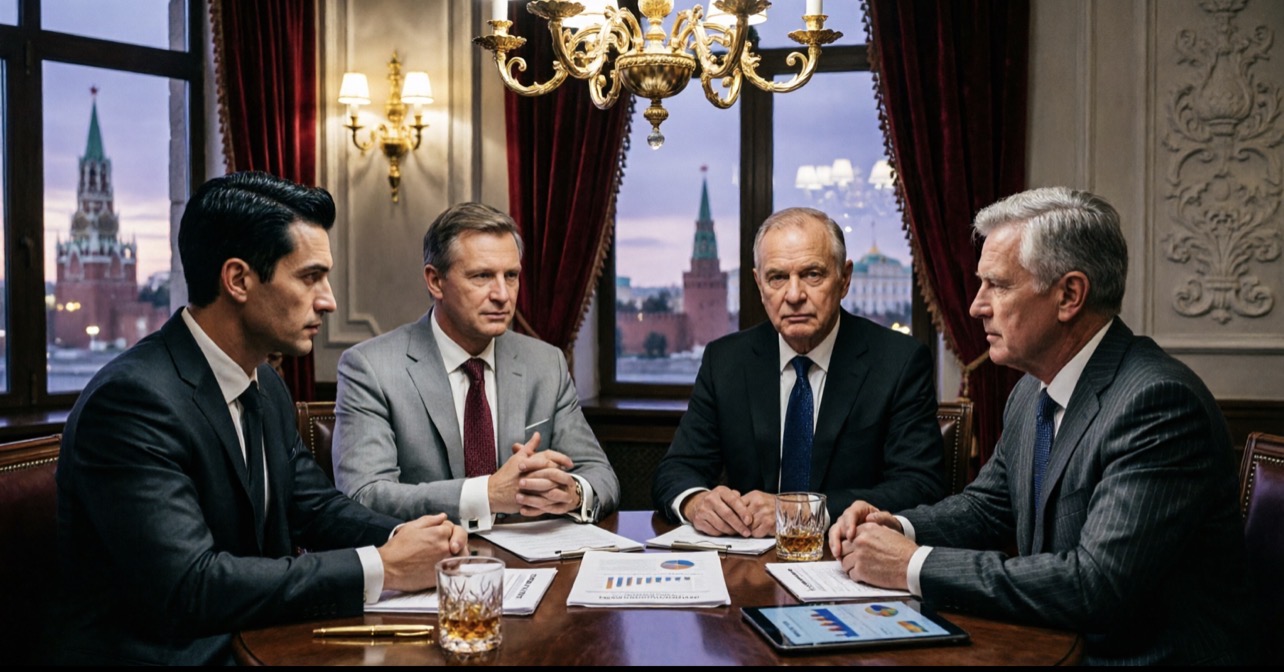
Jared Kushner and Steve Witkoff landed in Moscow on September 5 for their first trip to Russia since January, joined by officials from the National Security Council, State Department, and Treasury. They dined for three hours at an upscale restaurant a mile from the Kremlin, then rode the rest of the way in a Russian-government Aurus limousine, not the U.S. Embassy vehicle typical for high-level American visits.
Kushner greeted Putin by wishing him "happy holiday" in Russian, marking Moscow's City Day. The meeting ran three hours and ten minutes. Kremlin aide Yuri Ushakov called it "meaningful, constructive, extremely frank and trusting," and said the conversation "ranged beyond the battlefield" into prospects for major Russia-U.S. projects, discussed, in his words, "in considerable detail." The Associated Press reported the same.
None of that is how you'd describe a hostage negotiation, or a meeting between adversaries. It's how you'd describe two sides who like each other and are talking about more than one thing.
Who Was Actually In The Room
Start with who was actually in the room. Witkoff built his career in commercial real estate, hotels, mixed-use developments, complex capital stacks. Kushner runs Affinity Partners, a private equity fund that raised roughly $3 billion after 2021, mostly from Gulf sovereign wealth fundsOrbit →. Across the table sat Kirill Dmitriev, who holds two jobs at once: CEO of the Russian Direct Investment Fund, and Special Presidential Representative for International Investment and Economic Cooperation. He is, formally and simultaneously, a fund manager and a diplomat whose actual mandate is investment.
The United States did not send diplomats to negotiate the end of a war. It sent a real estate developer and a private equity manager, and they were received by a man whose government title is literally investment envoy. That is not what a peace negotiation looks like. It's what a capital-raising trip looks like, with a war as the occasion.
Not First Contact
This was not first contact. Five months earlier, in March, Dmitriev met Witkoff and Kushner in Florida. The Moscow Times reported the stated subject as Russian energy; Dmitriev told reporters afterward the talks covered restoring Russia-U.S. economic relations more broadly, and separately that Russian companies had been asked to prepare proposals for economic cooperation with the U.S. An economic channel between these three men has been running since at least the spring. September didn't start it. September confirmed it now has Putin's direct attention.
Dmitriev knows exactly how to build what a resumed Russia-U.S. economic relationship would need. His RDIF, created by presidential decree in 2011, spent the decade before the invasion pairing Russian state-adjacent projects with co-investment from sovereign wealth funds in the UAE, Saudi Arabia, China, and elsewhere — arrangements that gave foreign capital a structured, arm's-length entry point while Russian state interests kept control of the underlying assets.
Kushner's own investor base overlaps with exactly that capital pool. No public reporting establishes that a revived version of this structure is actually on the table for Ukrainian reconstruction, or anything else. But the template exists, the man who built it is now the direct Russian counterpart to Trump's son-in-law, and Ukraine's own reconstruction bill — an estimated $588 billion over the next decade, per the World Bank-led RDNA5 assessment — is exactly the size of hole that kind of vehicle is designed to fillRelated →.
The people in this room built this kind of structure before. The war just changed who's supposed to be embarrassed about it.
Why Washington, Not Brussels
Here's what makes Washington, rather than Brussels, the address Russia actually wants: roughly €210 billion in Russian central bank assets have sat frozen at Euroclear, the Belgian securities depository, since 2022. Russia holds title to that money. Europe holds custody and can maintain or lift the freeze — but releasing it wouldn't make it usable. The most dollar-cleared transactions run through U.S.-regulated correspondent banks, and OFAC can cut off any bank, anywhere, that processes transactions for a sanctioned Russian entity. Europe can hand the money back. Only Washington can make it spendable.
That's the actual reason Russia's investment envoy flew to meet the White House's investment envoys instead of anyone in Brussels. It isn't a diplomatic preference. It's Dmitriev correctly reading an org chart that Europe built and doesn't fully control the exit from.
Europe's Exposure Without A Seat
Europe is not a bystander here — it's exposed. In December, the European Council agreed to lend Ukraine €90 billion, structured so repayment depends on future Russian reparations, with the frozen assets held in reserve if reparations don't materialize. As of late August 2026, that plan was already straining: capitals were acknowledging the €90 billion loan may not stretch to cover 2026 and 2027 in full, and four EU member states had renewed their push to unlock the frozen assets directly — a push that had already stalled once, in December 2024, over Belgian objections. Europe supplied the weapons, absorbed the energy shock of cutting off Russian gas, and now has €90 billion of its own money riding on how a settlement it isn't negotiating turns out.
Europe has a veto — nothing gets released from Euroclear without a European legal act. What it doesn't have, on the documented record, is a seat, or even a stated position on what it would accept from a Russia-U.S. economic track running in parallel to the war talks. A veto without a design isn't leverage. It's just the ability to say no to a deal you didn't help write.
The Absent Parties
Back in the actual room: Volodymyr Zelensky wasn't in it either. He learned what was discussed afterward, in a briefing, and in exchange agreed to hold Ukrainian strikes on Moscow through Monday so the American delegation could travel safely. Putin, in a matching gesture, ordered a 72-hour pause on strikes against Kyiv — a pause that didn't stop air-raid warnings within the hour, didn't extend to the rest of the country, and was preceded, hours earlier, by a large-scale strike on both of Kyiv's main airports that Zelensky said was Russia's reaction to news the delegation might fly in. Witkoff and Kushner did fly in afterward, traveling overland into Kyiv after their plane stopped in Rzeszów, PolandRelated →.
Two capital-markets people met their Russian counterpart to discuss, by his own account, business opportunities "in considerable detail." The country actually being fought over wasn't at the table. The institution actually holding the money wasn't at the table.
What's left in the room is exactly the two parties who'd need each other to turn a ceasefire into a return on investment. And that is where this Old Goat stands.
Ushakov called it a peacemaking visit. Based on who showed up and what they discussed, it reads more like a capital call.