What the Department Asked For
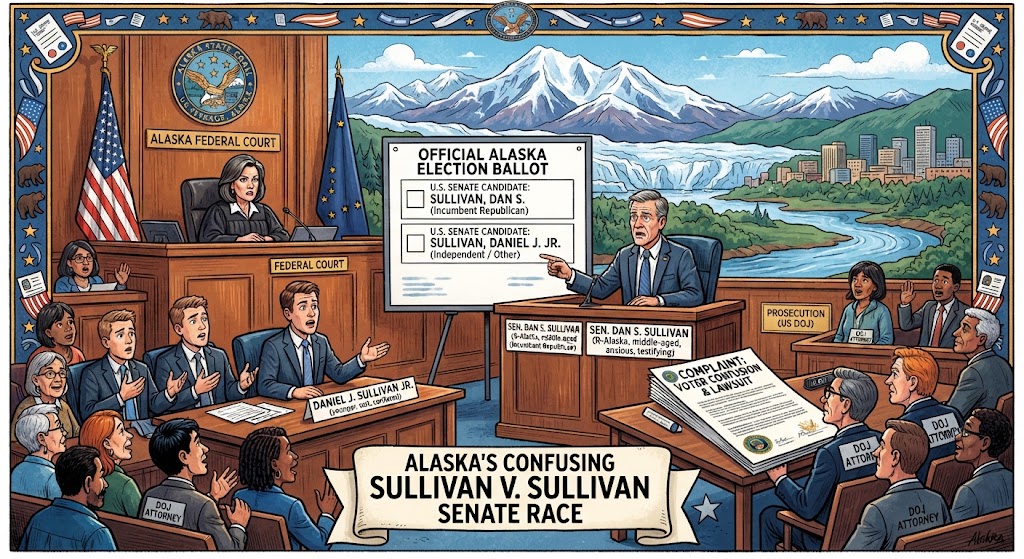
REPORTED. On Thursday, Oct. 22, the Justice Department sued Alaska's election officials in federal court in Anchorage. The 14-page complaint is signed by Associate Attorney General Stanley E. Woodward. It asks the court to bar the state from certifying the U.S. Senate result if Sen. Dan S. Sullivan, the Republican incumbent, loses narrowly to Mary Peltola, the Democrat, while Daniel J. Sullivan Jr., a retired teacher from Petersburg, is on the ballot.
The trigger, in the complaint's words, is that "(1) Senator Sullivan does not win the election; and (2) had all votes cast for Daniel J. Sullivan been cast instead for Senator Sullivan and Alaska's rank-choice process played out accordingly, Senator Sullivan would have won the election." In that case the department wants certification held until "an investigation to determine whether votes cast for Daniel J. Sullivan were meant to be cast for Senator Sullivan." Ballots are secret. Nobody has explained how such an investigation would work.
On Friday the president said whose idea it was. "I'm the one that said do it," he told reporters. He had already written that "it's ridiculous that the Court didn't stop this SCAM."
What Alaska Already Did
REPORTED. Republicans spent months trying to get the second Sullivan off the ballot, arguing he is a Democratic plant. He registered as a Republican only recently, has given to Democrats including Peltola, and has said he worked with a Democratic strategist to qualify. In June the Alaska Supreme Court ruled he could stay on. The ballot lists no party for either man; the senator's line identifies him as the incumbent. "My intention is not to trick people," the Petersburg Sullivan told the Times in August.
REPORTED. In the August primary, Alaska Public Media reports, Sen. Sullivan drew more than 68,000 votes and Daniel J. Sullivan drew 4,107, about 2 percent. Peltola led the field; by the later count she had 49.5 percent to the senator's 41.4. Even if every vote for the Petersburg Sullivan had gone to the senator, he would still have trailed in the primary. Ranked-choice voting also cuts against the department's theory: a voter who ranks both Sullivans has that vote flow to the senator once the other is eliminated.
Alaska's other Republican senator, Lisa Murkowski, wrote that "Alaskans don't need any help voting for their preferred candidates," and that the department "should never have filed this lawsuit." Sen. Sullivan's campaign said he did not ask for the suit. Derek Muller, a Notre Dame election-law professor, told Alaska Public Media: "The statute simply doesn't let the Department of Justice enjoin certification." David Becker of the Center for Election Innovation & Research said he could not recall the federal government ever seeking to block certification, "and certainly not 11 days before an election."
The Old Goat's Two Cents
OPINION. The Old Goat has never heard of a last name as a disqualification. If a shared name is grounds to hold up a result, the Democrats can sue too whenever their candidate loses a close one. Nobody should want that rule.
OPINION. The Old Goat feels Alaskans are smarter than that and will not be confused about which Sullivan they want to win. One has held the seat since 2015 and is running for a third term. The other is a teacher from a fishing town. The ballot says which one is the incumbent.
INFERENCE. The point of a suit like this may not be to win it. Filed before a vote, it puts a question mark over one outcome only, the one the president does not want. It also arrives alongside the department's suit against California's voter rolls, with a hearing next week. The second Trump administration has charged about 150 people nationwide with illegal voting or registration, according to the Times, in a country where tens of millions vote. Watch whether the same template, a suit filed before the votes are counted asking a judge to hold one result, shows up in other close races.
Related: the Justice Department's other election moves are in The Second Knock →.