In the first days of March 2026, the Secretary of the Army picked up a phone and called a former Google chief executive.
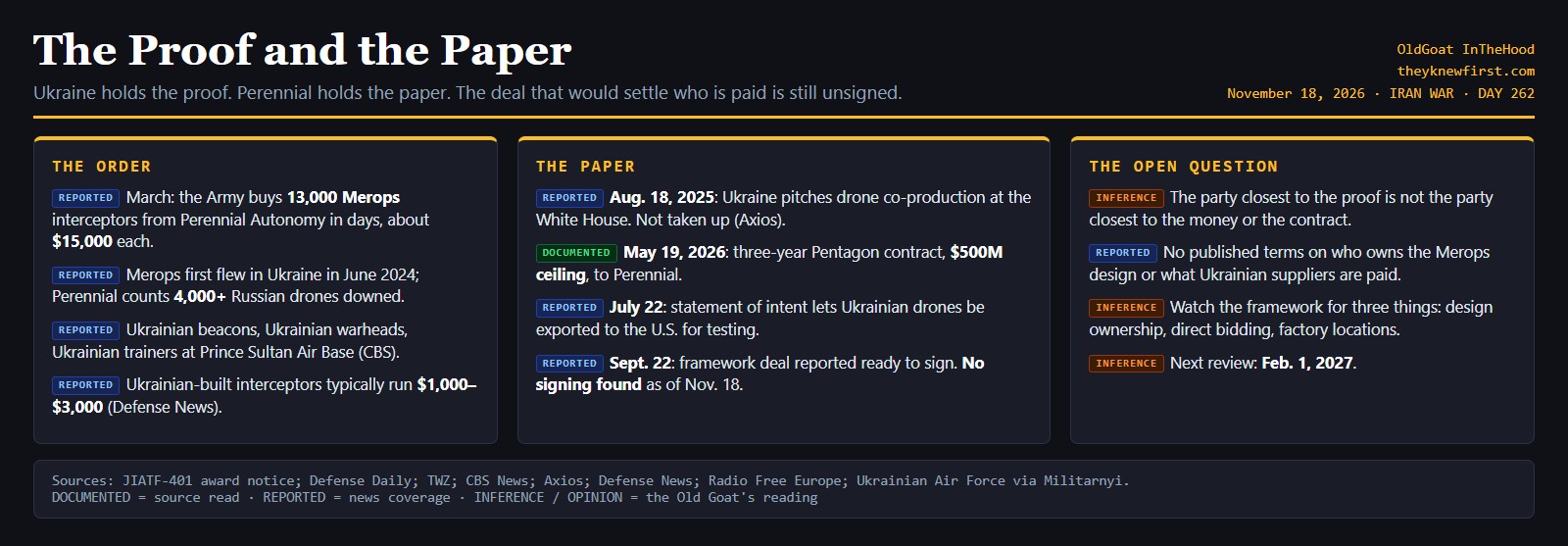
Iran had been firing drones at American bases for less than a week. The Army needed something that could stop a cheap flying bomb without spending a missile worth millions on it, and it needed it before the next wave. Dan Driscoll, according to CBS News, asked Eric Schmidt for 13,000 interceptor drones called Merops and 10,000 reconnaissance and strike drones called Bumblebee. Schmidt agreed. The drones reached the American military within days. Defense Daily →
It is a good story about speed, and it is true, but the call went to Schmidt, not to Kyiv, and that detail carries the rest of this investigation. The thing Driscoll ordered had been tested for almost two years against Russian drones over Ukraine, and it contained Ukrainian guidance units, Ukrainian warheads and Ukrainian know-how. Seven months earlier, a Ukrainian delegation had walked into the White House and offered the American government exactly this: Ukrainian drone technology, American factories, a shared business. Nothing came of the offer.
This dispatch does not ask who is right. It asks which road the knowledge travelled, who owned the road, and what has been written down about the money at the end of it. The answer, as of this writing, is that the money is the one part nobody has written down.
The Arithmetic Nobody Can Win
Start with why anyone needed a phone call at all.
On Saturday, Feb. 28, 2026, American and Israeli aircraft began striking Iran. Iran answered with hundreds of missiles and, in far larger numbers, with Shaheds, the cheap propeller-driven drones Russia had been sending against Ukrainian cities for years. It aimed them at American bases across the Gulf and the wider Middle East. Iran tab →
A Shahed is not sophisticated. It is a slow, loud flying bomb that follows a programmed route and explodes at the end of it. Analysts put the price of one at roughly $20,000 to $50,000. The usual defense against an incoming aircraft is a missile, and an air defense missile of the Patriot class costs millions. You can fire it at a drone worth a fraction of its price. You can do it a hundred times. At some point you notice that you are losing the arithmetic even when you win every individual fight.
Fox News reported that one of the Iranian attacks hit a tactical operations center in Kuwait and killed six Americans. The question that reached the people responsible for protecting American troops was narrow and urgent. Who has already solved this, and can we have it next week?
Only one country had been solving it every night for years. Russia launched 948 drones at Ukraine in the 24 hours to 6 p.m. on March 24, the largest barrage of the war, according to Ukraine's air force, and Ukrainian defenders shot down or suppressed 906 of them. The country that stops that many drones a day does not do it with Patriots. It does it with a layered system of cheap interceptors, mobile fire teams and software, and it had spent two years finding out which parts of that system work. Militarnyi →
The Pentagon did not discover a new weapon in March. It discovered that the answer already existed and that somebody else had it.
What Was in the Box
The Merops was not invented in a California laboratory last spring.
Ukrainian forces first used it against Russian-operated Shaheds in June 2024. By the company's own count it has helped destroy more than 4,000 Russian drones in Ukraine. Poland and Romania fly it along NATO's eastern edge. Lithuania bought 48 on April 22.
The company behind it has changed its name more than once. Forbes reported that Schmidt launched it quietly in 2023 as White Stork. It was then called Project Eagle, and it now trades as Perennial Autonomy. Defense News described how it began. Schmidt set out to build attack drones. His Ukrainian hosts talked him into something else: the better investment, they argued, was defensive, drones built to catch other drones in the air.
The idea, then, came from Ukraine. What about the parts?
CBS reported that the Merops uses AI beacons manufactured by Sine Engineering, a Ukrainian technology company, and Ukrainian warheads. A beacon, here, is the small electronic unit that lets the interceptor find and follow its target. Sine describes itself as supplying communications, navigation and multi-drone control to more than 200 drone makers in Ukraine, and CBS reported that it recently received a multimillion-dollar investment from the U.S.-Ukraine Reconstruction Investment Fund. Defence24, relayed by the Ukrainian outlet Militarnyi, wrote that the Merops system was largely developed by Ukrainian engineers for Perennial.
The Old Goat wants to be careful about the size of that claim. It is documented that Ukrainian forces flew the Merops first. It is documented that key components are Ukrainian. It is reported, not independently confirmed, that Ukrainian engineers did most of the design work. What the public record does not show is how much of the value, the patents or the profit stayed in Ukraine.
There is a second set of facts in the CBS reporting that matters more than the first, because it is about what the speed actually consisted of. The drones reached the American military within days. They took weeks to become operational, CBS reported, because the Ukrainian components arrived late. Before the interceptors could be used in combat, Ukrainian expertise was needed to connect them to American air defense radars. Ukrainian personnel also trained American service members at Prince Sultan Air Base in Saudi Arabia on Sky Map, a command platform for identifying Shahed-type threats and coordinating interceptors.
Put that together and the box looks different. The label said an American company, and the drones reached the American military within days. The working parts, the integration knowledge and the training came from Ukraine, and the weeks it took to make everything operational were, in CBS's account, the weeks it took for Ukrainian components to arrive. When Deborah Fairlamb, a founding partner of Green Flag Ventures, spoke to CBS about the lesson, she said it is not like a rifle that you point and shoot. The value, she said, is in how the technology is used.
What the Army bought was a Ukrainian way of fighting, delivered under an American label.
Kyiv did more than supply parts. According to the same reporting, it sent interceptor drones and pilots to the region to help. That fact appears in the story as a support line. In structural terms it is the first sign that Ukraine was not only a supplier but a participant, and that the relationship being described was not buyer and seller.
The Pitch That Came First
The label is not the only thing in the story that came from Kyiv. The proposal did too, and it came earlier.
Ukrainian officials first pitched drone cooperation at the White House on Aug. 18, 2025, after President Trump privately praised Operation Spiderweb, the Ukrainian attack on Russian bombers parked deep inside Russia. Axios later described the meeting. The Ukrainian side framed the idea as a business deal: American factories, American jobs, Ukrainian know-how. A Ukrainian official told Axios the country could build up to 20 million interceptor drones but had the resources to produce only half of that. Axios →
Axios reported on March 10, 2026 that the administration did not take up the offer, and that U.S. officials now call that decision one of their biggest mistakes. The White House disputed the framing. The Old Goat can report that judgment as theirs. Nobody can prove it was a mistake, because nobody has a record of what would have happened otherwise.
Two days later, on March 12, Zelensky said Ukraine was still waiting for White House approval of a major drone production agreement. By then the Iran war was two weeks old, the Army had made its Merops order, and the proposal had been sitting for most of a year.
Sit with that order of events for a moment. In August, a country at war offers its proven interceptors, its factories and its engineers to the most powerful military in the world. Nothing happens. In February, Iran fires drones at American soldiers. Within days the Army buys thousands of interceptors from an American company whose product was proven in that same country, with that same country's parts.
The pitch and the purchase never sat at the same table. One was built out of the other, though.
There is a way to read this that is too neat, and it should be named. It would say that Washington took the Ukrainian idea, handed it to a friendly American businessman and kept the proceeds. Nothing in the public record shows that. What the record shows is two separate decisions, a refusal in 2025 and an order in 2026, joined by a fact: the product the Army ordered had been shaped by the same war the Ukrainians were pitching from.
The public record shows a pitch that was never answered and a product that arrived by another road. It does not show how one led to the other, or whether it did.
Two Prices
There is a number that makes this more than a story about labels.
A Merops costs about $15,000 per interceptor. Driscoll said the price could fall to $10,000 at scale, and later suggested larger orders could bring it to $3,000 to $5,000, according to TWZ. A Shahed costs $20,000 to $50,000. Against a Patriot missile the Merops is a bargain, and that is exactly why the Army wanted it. Driscoll put it this way to lawmakers in April, according to Defense News: "That puts us on the right end of the cost curve."
Defense News, in May, made a second comparison. Ukraine's own interceptors, it reported, are cheaper than the Merops and have been in combat longer, with typical Ukrainian-built interceptors running $1,000 to $3,000 a unit. Four Ukrainian-built interceptors dominate the Shahed-killing fleet: SkyFall's P1-SUN, the Wild Hornets' Sting, the Ukrainian-British Octopus and General Cherry's Bullet. Defense News →
There are, then, two products. One is American-branded, with Ukrainian parts, at about $15,000. The others are Ukrainian-made, at a lower price. The Army bought the first.
There is an honest reason that might be reasonable, and it deserves its full weight before the rest of the argument. An October analysis by the Drone Warfare research site makes the point that the price of a single round is only part of the cost of a system. The radar, launcher, ground station and four-person crew are fixed costs of every set. A cheap round does not make a cheap defense. The figure on the sticker is not the cost of protecting a base.
Even so, the gap needs explaining. Part of the explanation may not be about engineering at all. A buyer inside the American system finds it easier to buy from an American company, which has a U.S. address, a U.S. legal structure and a contracting history. In March, the Ukrainian makers had the technology and the battlefield record, but no comparable record of selling to the Pentagon.
INFERENCE. That is a reading of the order of events, not a finding. Nobody has published why the Army chose as it did. What can be said is that the missing deal was supposed to close exactly this gap.
There is also a scale that the price comparison hides. The Army acquired about 50,000 drones of all kinds in 2025, according to Driscoll, as CBS reported. Zelensky says Ukraine aims to make 10 million this year. The Pentagon's Drone Dominance Program hopes to buy more than 200,000 drones by 2027. One partner is learning to produce at a scale the other has not yet needed. The distance between those numbers is the real reason Ukrainian know-how is valuable to Washington. It is also the reason the terms of how it is shared matter so much.
Four Documents, One Gap
Four different things happened in this story, and they are easy to confuse: an order, a contract ceiling, a permission to test and a framework deal that is still unsigned. Here they are in order.
The order came first. In March the Army asked for 13,000 Merops and 10,000 Bumblebee, and by April Driscoll told lawmakers the Army had bought the 13,000 and was deploying them. The Army later explained, according to The War Zone, that it turned the Merops into a formal program in 142 days. The usual time for an item to cross that line is measured in years. TWZ →
The ceiling came second. In May, the two governments drafted a memorandum outlining a possible defense agreement. On May 19, the Pentagon's counter-drone task force, JIATF-401, awarded Perennial Autonomy a three-year contract with a ceiling of $500 million. The contract covers the Merops, the Bumblebee quadcopter and a mid-range strike drone called Hornet. A ceiling is not spending. It is the most the contract allows, and the public record does not say how much has been spent against it. A Perennial spokesperson declined to say how many units it buys. On May 31, Zelensky said on American television that Ukraine still had no bilateral drone deal with the United States. Washington, he said, wanted to check every type of Ukrainian drone first. The holdup, he said, sat on the American side. Award notice →
The permission came third. On July 22, according to Radio Free Europe, the two countries signed a statement of intent that allows Ukrainian drones to be exported to the United States for military testing and evaluation. It is not a production contract. It is not a purchase. It is permission to try. The report cites two anonymous sources and gives no named signatories. Six Ukrainian companies were reported cleared to export about a hundred drones each for the Pentagon's Drone Dominance program, and a Ukrainian maritime drone company, UFORCE, announced a memorandum with an Oregon shipbuilder, ReconCraft, to build its Magura boats in the United States. By July 31, according to CBS, F-Drones had delivered 2,000 F10 first-person-view drones under the Drone Dominance program, the first Ukrainian drone authorized for export to the U.S. under that initiative. RFE/RL →
On July 10, Zelensky told reporters that testing was underway and that the feedback was "very positive." He said the full drone deal would come after the testing, as a next stage, and he valued the partnership at $35 billion to $50 billion. Reports describe it as a 50-50 production venture drawing on up to 200 Ukrainian companies. The Patriot interceptor license Trump pledged at the NATO summit in Ankara on July 8, Zelensky said, is a separate track.
The framework deal is the fourth thing, and it is the one that does not yet exist. On Sept. 22, CBS reported, citing three sources, that Ukraine was ready to sign, possibly at the United Nations General Assembly that week, though the signing might slip until the United States was ready. The deal would go beyond contracts with a few Ukrainian companies and create a broader framework for leading Ukrainian firms to work directly with American companies and the military. CBS gave no dollar value and reported no response from the White House or the Pentagon. As of Nov. 18 the Old Goat has found no confirmation that it has been signed, and no published terms. CBS →
As things stand, the American military has bought thousands of interceptors from an American company that is built on Ukrainian technology, and it is testing a sample of drones from Ukrainian companies directly. The agreement that would let Ukraine sell and build on its own terms has been reported ready on the Ukrainian side since September.
The order was signed in days. The permission took four months. The deal has taken more than a year, and it is still not signed.
Who Holds the Switch
In October, the Old Goat wrote about what happens when a capability depends on someone else's terms. Ukraine's interceptor drones hit a speed limit set by a satellite plan that was designed for campers and boat owners. The lesson there was not about one company. It was about where a capability sits when it runs through another party's system. The Speed Limit →
The Merops story is the same lesson one layer up. The layer is not satellites. It is the brand, the contract and the channel.
Look at what the structure does. The proven technology comes from Ukraine. The channel into the American system is an American company. The Pentagon's contract ceiling is $500 million, with Perennial. Production is expanding to Germany, with a Munich partner called Twentyfour Industries. Payload loading, one analysis says, will happen at a U.S. Army plant. A Ukrainian soldier has fought with the system, a Ukrainian company supplies its brain, and the Ukrainian state keeps a rule that its own forces get first claim on production and only the surplus goes abroad.
None of that is improper. It does create a pattern worth naming. The party closest to the proof is not the party closest to the money, the contract or the decision about where the next factory goes. Whoever holds the contract has a say over who is in the supply chain and on what terms. That is not the same as setting the price alone, since contracts, competition and bargaining power all push back. It is a seat at the table that the party with the proof does not yet have.
There is a version of this story that is a plain partnership. There is another version that is the old pattern, in which a country at war supplies the experience and someone else collects the return. The public record supports neither version completely, because the terms between Ukraine, Sine Engineering, Perennial and the Pentagon have not been published. What it does support is a narrower and more useful claim: the question of who benefits is open, and it is open not because of a secret but because the agreement that would settle it has not been signed.
There is a small fact that shows how real the knowledge transfer is. CBS noted that in August the Army phased out a drone battalion that had studied Ukraine's drone warfare, and that two senior generals were removed or retired early this year. The report does not connect that decision to the Merops, and nothing the Old Goat found shows that the commercial channel through Perennial replaced the battalion. The two facts only sit side by side: the Army reduced one internal channel for learning from Ukraine, and a commercial channel carried the Merops. Whether one had anything to do with the other is not documented.
Ukraine holds the proof. Perennial holds the paper. What the paper is worth to the proof is the one number nobody has published.
Who Pays
It is easy to lose the people in a story about contracts. They are there.
On March 24, Russia launched 948 drones at Ukraine in a single day. A country absorbing that cannot wait for a framework agreement to be perfected. Capacity that is not paid for does not become drones. It becomes a factory that is ready and idle, which is what Ukrainian officials told Axios when they said they could build up to 20 million interceptors but had the resources for only half.
In Kuwait, six Americans died in one attack. In Ukrainian cities, people spend nights in corridors and basements while the drones come in. A figure like 948 drones in a day is not a statistic to the people under them. It is a night of deciding, again, whether to go down the stairs.
Every interceptor that gets built and flown earlier is a night someone does not spend that way. That is the argument for speed, and it is a good one.
Speed may carry a cost that is easy to overlook, because it would be paid later and by someone else. Nobody has published how the money flows. If the first wave of American money stays with the label, Ukrainian makers have less to build the next system with. If it flows down to suppliers such as Sine Engineering, it could do the opposite, and the investment fund that backed Sine suggests some of it does. The public record cannot settle which.
The Washington Times raised a related worry in July. Localized production abroad, it wrote, could slow the rapid design cycles that made Ukrainian systems so effective in the first place. A design that changes every few weeks at the front does not survive a supply chain that takes months to retool.
In September, Perennial gave 250 Surveyor interceptors and five ground stations to Ukraine's defense forces, according to Militarnyi. That is a generous act, and the Old Goat does not read it as anything else. It is also a small illustration of a larger fact: the system that Ukrainians helped prove now reaches Ukrainian soldiers through a company that sits between them and the system.
Ukraine, meanwhile, has not waited for Washington. CBS reported that it has signed defense agreements with Saudi Arabia, Qatar, the United Arab Emirates and others that match foreign financing with Ukrainian manufacturing. That is evidence that the Ukrainian side has other doors, and is using them. Whether the American door matters most, and for whom, is the thing the unsigned deal will decide.
The Strongest Objection
The strongest counterargument does not dispute any of the facts. It says that what happened here is not an extraction but a rescue, and that a fast channel beating a slow one saved lives.
Consider what the Army needed in the first week of March. It needed thousands of interceptors that worked, immediately, with American paperwork. A Ukrainian company had the product and the record. It did not have an American contracting history, and Ukraine's export rules put its own forces first, which is exactly what a country at war should do. An American company with Ukrainian engineers, Ukrainian parts and a direct line to the Army could say yes in days. Perennial did. The Merops reached troops in the region quickly. By the Army's own account the system became a formal program in 142 days. Production in Germany adds capacity for European buyers who also need cheap interceptors.
Money has moved back, too. The reconstruction fund that invested in Sine Engineering is American and Ukrainian money. Perennial's donation reached Ukrainian soldiers. The company's own record was built on Ukrainian testing, which Perennial has acknowledged by describing its systems as proven in Ukraine.
The strongest version, then, is a division of labor: Ukraine supplies the knowledge, an American company supplies the access, and the soldiers on both sides get the protection. If the framework deal is signed on fair terms, it may turn out to be the first stage of a partnership between equals. That reading is structurally serious, and it explains why nobody in this story needs to have acted in bad faith.
The reading offered here does not claim bad faith. It claims something narrower: the road by which Ukrainian knowledge reached the American military ran through a commercial intermediary, the public record does not show how the value on that road was divided, and the agreement which would settle it is the part still missing. The division-of-labor reading accommodates the speed. It does not accommodate the silence about the terms. Both can be true at different levels: the channel can have been the right choice in March, and the terms can still be the open question in November.
What the Record Does Not Show
It helps to be exact about where the evidence stops, because this story invites a tidier ending than the facts allow.
The record shows five things: Ukraine pitched Washington in August 2025, the Army later bought about 13,000 Merops from Perennial Autonomy, Ukrainian companies supply parts to that system, Ukrainian-built interceptors are reported to cost less, and a testing agreement followed in July.
It does not show that anyone in Washington took the Ukrainian pitch and handed it to an American company, or that the August proposal and the March order were ever discussed together. It does not show what Ukrainian suppliers were paid or who owns the design. The claim that Ukrainian engineers largely developed the Merops rests on reporting the Old Goat could not confirm independently, so it is treated as reported, not established. It does not show how much of the $500 million ceiling has been spent, or whether Ukrainian firms hold any of the subcontracts underneath it.
The Old Goat also could not confirm whether the larger deal was signed after the September reports that it was ready. If it was, the picture may move toward the partnership reading. A reader who finds the signed text should trust it over anything written here.
The pattern is visible. The motive is not. The useful question sits in the gap between the two.
After the Record
What should a reader watch, if not the headlines about whether a deal is signed?
Watch what the signed text says about three things, and keep one limit in mind. A bilateral framework between Washington and Kyiv is not the private contract between Perennial and Sine Engineering, and it need not disclose it. The first question, who owns the designs that came out of the fighting, may stay unanswered even after a signing. If the intellectual property of the Merops sits with Perennial alone, Ukrainian engineers helped build an asset they do not hold, but that would show up in company contracts, not necessarily in a government agreement.
The second and third questions are the ones a bilateral deal can answer. Can Ukrainian makers bid directly for American orders, or must every dollar still pass through a U.S. intermediary? Where do the factories go? Production in Germany and Oregon is capacity abroad, and a framework that lists only foreign sites is a different thing from one that lists Ukrainian ones.
None of this requires classified access. The framework will either exist or not, and what it says on those two points will be visible the day it is published. The ownership question may need another kind of evidence: a company statement, a court filing, a procurement record.
Go back to the phone call. In the first days of the war with Iran, the Army secretary called Eric Schmidt because the answer to an urgent problem already existed. It existed because a country had been forced to solve that problem every night for four years.
A country at war offered a business plan in August 2025. It was not taken up. Seven months later, a war elsewhere created a desperate need for exactly what had been offered, and an American company that had spent almost two years learning in that country met it within days. The first order went to the American label, not to the Ukrainian-built interceptors that, by Defense News's account, cost less. The deal that would let Ukrainian makers sell on their own terms was, by the last report the Old Goat found, ready but unsigned.
This is not a scandal. Nobody has shown bad faith, and procurement in a crisis is allowed to be messy. It is something more ordinary, and more useful to look at: what a gap between a battlefield and a contract looks like when it is measured in dollars.
When the agreements between Washington, Kyiv and the companies in between are finally written down, will they say who was paid for what was learned there, or only who delivered it?