What SpaceX Has Bought
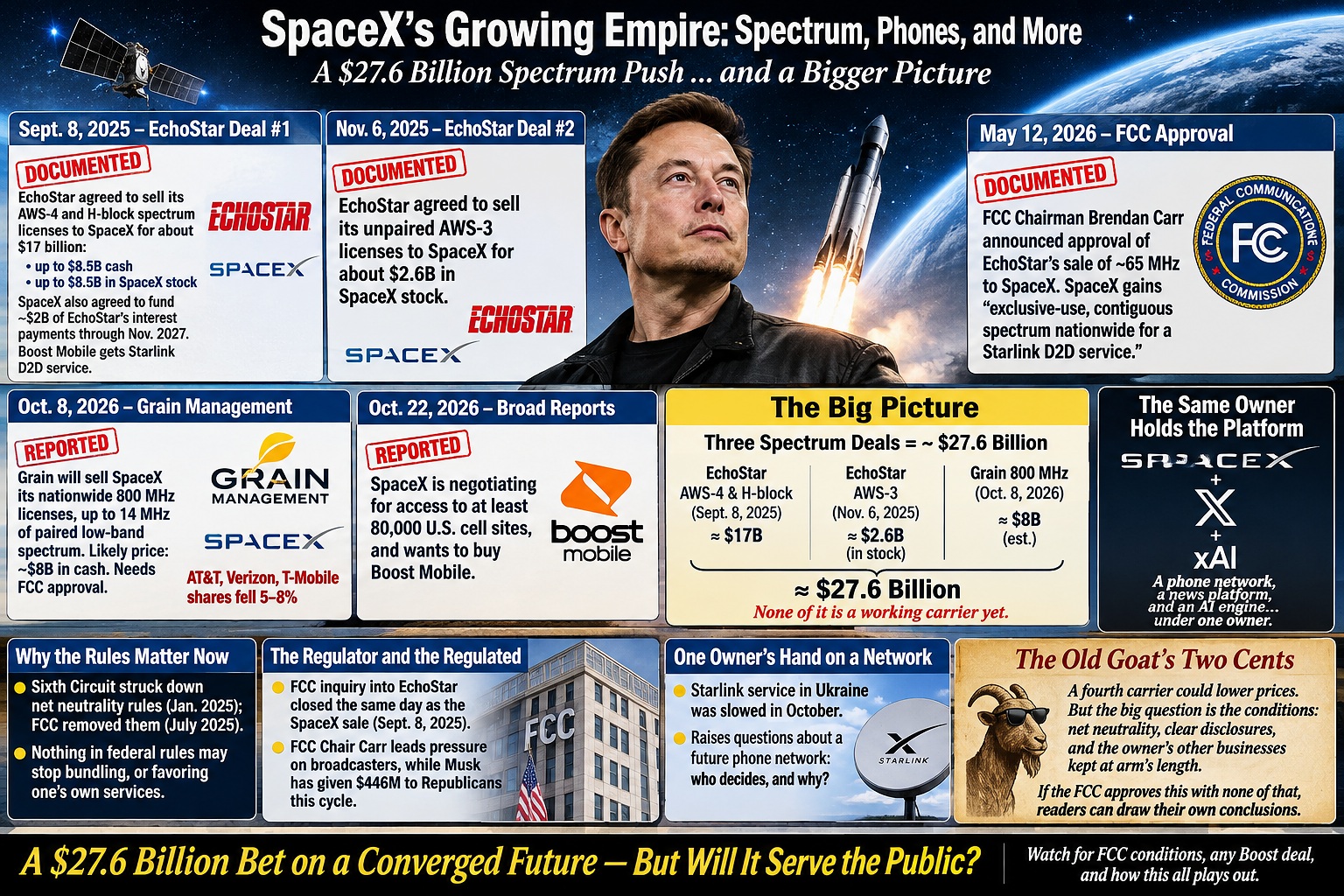
DOCUMENTED. On Sept. 8, 2025, EchoStar agreed to sell its AWS-4 and H-block spectrum licenses to SpaceX for about $17 billion: up to $8.5 billion in cash and up to $8.5 billion in SpaceX stock. SpaceX also agreed to fund about $2 billion of EchoStar's cash interest payments through November 2027. EchoStar's Boost Mobile customers get access to Starlink's direct-to-cell service as part of the deal. EchoStar 8-K →
DOCUMENTED. On Nov. 6, 2025, EchoStar agreed to sell its unpaired AWS-3 licenses to SpaceX for about $2.6 billion in SpaceX stock. EchoStar 8-K →
DOCUMENTED. On May 12, 2026, FCC Chairman Brendan Carr announced approval of EchoStar's sale of about 65 megahertz to SpaceX. The FCC's release says SpaceX gains, "for the first time ever," access to "exclusive-use, contiguous spectrum nationwide for a Starlink D2D service and other offerings." FCC release →
REPORTED. On Oct. 8, 2026, Grain Management announced it would sell SpaceX its nationwide 800 MHz licenses, up to 14 MHz of paired low-band spectrum. Grain's release gave no price; people familiar with the deal put it at about $8 billion in cash. It still needs FCC approval. AT&T, Verizon and T-Mobile shares fell 5 to 8 percent in early trading on the news. Grain had bought the same licenses from T-Mobile for $2.9 billion in cash plus other spectrum. Fierce → Broadband Breakfast →
REPORTED. Bloomberg reported Oct. 22 that SpaceX is negotiating for access to at least 80,000 U.S. cell sites, about half the country's purpose-built towers. Crown Castle's chief executive said only that the company is "talking to all parties." TD Cowen estimates a nationwide ground network would cost more than $80 billion. TechCrunch reported Nov. 2 that SpaceX also wants to buy Boost Mobile. Bloomberg via Star-Advertiser → TechCrunch →
INFERENCE. Add the three spectrum deals and the total is about $27.6 billion. None of it is a working carrier yet. Building one needs the towers, and the Grain sale needs the FCC.
The Same Owner Holds the Platform
REPORTED. SpaceX acquired xAI in an all-stock deal announced Feb. 2, 2026. Bloomberg-sourced reports valued SpaceX at $1 trillion and xAI at $250 billion; a Reuters report put xAI at $125 billion. xAI had absorbed X in March 2025, so X and the Grok chatbot now sit inside SpaceX. Fortune →
INFERENCE. If the wireless plan works, one company would own a phone network, a major news-distribution platform and an AI answer engine. Any one of those is ordinary. All three under one controlling owner is not.
Why the Rules Matter Now
REPORTED. The Sixth Circuit struck down the FCC's net neutrality rules in January 2025, and Carr removed the defunct rules from the books in July 2025. Federal oversight of how carriers treat traffic is now mostly disclosure. A few states, including California, have their own rules. Broadband Breakfast →
INFERENCE. Nothing in federal rules would stop a carrier that also owns X and Grok from bundling them, speeding them up, or not counting them against a data cap. The Old Goat found no report that SpaceX plans to do any of that. It would be easy to spot if it did.
The Regulator and the Regulated
REPORTED. The FCC opened its inquiry into whether EchoStar was using its spectrum after SpaceX told the commission EchoStar might be "warehousing" it. On Sept. 8, 2025, the day the SpaceX sale was announced, Carr wrote to EchoStar chairman Charlie Ergen that the inquiry was over, Bloomberg reported. Bloomberg via TipRanks →
DOCUMENTED, on this site: the same FCC chairman leads the pressure on broadcasters, in Who Holds the Megaphone →. Musk gave about $446 million to Republican committees this cycle through Oct. 14, per FEC records, in Texas Is Not for Sale →.
INFERENCE. The Old Goat found no evidence of a trade between the money and the approvals. The concern is the structure: the agency licensing one media owner's network is leaning on other media owners at the same time.
One Owner's Hand on a Network
REPORTED. In October the military-grade Starlink service Ukraine depends on was slowed, and accounts conflict over whether Musk acted on his own or after talking to the president. The full account is in Who Holds the Off Switch →.
INFERENCE. Either version is a warning for a phone network: a private owner acting alone, or a government working through a private company with no clear line of accountability.
The Other Side
REPORTED. A fourth national carrier could push prices down. Analysts at LightShed warned that a joint venture among the big three carriers to keep SpaceX out could itself raise antitrust questions. JPMorgan analysts say SpaceX would likely need a ground tower network to match carrier quality, and New Street Research says SpaceX would still lag the big three in low-band spectrum. Service on SpaceX's own airwaves is targeted for early 2028, and the EchoStar transfer is reportedly targeted for late 2027. The FCC says the licenses were underused. CNBC →
The Old Goat's Two Cents
OPINION. The Old Goat is not against a fourth carrier. Prices are too high and three companies have had it too easy. The question is the conditions. When the FCC rules on Grain, the public should see whether it requires the network to treat all traffic the same, to disclose how it answers government data requests, and to keep the owner's other businesses at arm's length. If the agency approves it with none of that, readers can draw their own conclusions.