The Case File
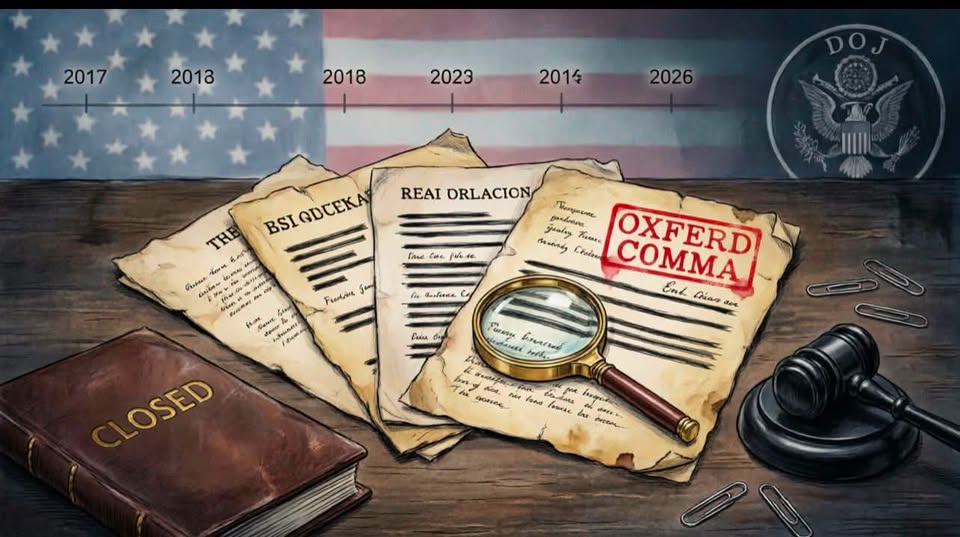
On August 5, 2026, the White House Government Transparency Task Force released declassified FBI memos revealing a counterintelligence investigation, codenamed Oxferd Comma, opened May 16, 2017 — one week after Trump fired FBI Director James Comey. The opening memo, approved by then-FBI General Counsel James Baker and then-Assistant Director for Counterintelligence William Priestap, stated the FBI had "an articulable factual basis" to examine whether Trump "may be or has been, wittingly or unwittingly" acting on behalf of the Russian government, and whether the Comey firing itself was evidence of it.
The declassified record places a specific sequence on paper: Oxferd Comma opened May 16; Acting FBI Director Andrew McCabe personally briefed Rosenstein that same day; Rosenstein appointed Robert Mueller special counsel the next morning, May 17. Mueller's appointment order authorized him to investigate "any links and/or coordination between the Russian government and individuals associated with the campaign of President Donald Trump" — a criminal-investigation mandate under DOJ's Part 600 special-counsel regulations, which were written for criminal matters and don't squarely contemplate delegating a counterintelligence probe. Responsibility for Oxferd Comma was formally transferred to FBI personnel assisting Mueller after his appointment — but under a mandate scoped to the special counsel's criminal jurisdiction, independent legal analysis published in the years since has noted the counterintelligence prong — whether Trump himself was compromised, separate from whether a crime was committed — never got the same institutional attention.
Closed Before He Testified, Not After
Mueller submitted his final report to Attorney General William Barr on March 22, 2019. His report's first volume found insufficient evidence of a criminal conspiracy between the Trump campaign and Russia; its second volume, on obstruction, reached no conclusion either way. Neither volume states a finding on whether Trump himself had been compromised — the specific question Oxferd Comma was opened to answer.
The declassified closing memo dates the case's end to April 9, 2019 — roughly two weeks after Mueller's report was submitted, and more than three months before Mueller's July 24, 2019 testimony to Congress, in which he said the report did not "totally exonerate" the president and confirmed Trump could still face prosecution after leaving office. Mueller's testimony that day was widely read, in the moment, as leaving open whether aspects of the broader inquiry continued. The declassified record now shows one specific piece of it — the counterintelligence half — had already been closed for months by the time he sat down to testify.
The opening memo, the closing memo, and Rosenstein's appointment order are now all part of the same declassified record — three documents that, read together, show a counterintelligence question opened, handed to an office authorized only to answer a different one, and closed without either question being publicly resolved.
The Name Itself
The codename is spelled "Oxferd Comma" throughout the declassified memos — not "Oxford." Multiple outlets reviewing the documents, including one that consulted a document expert, describe the full internal encoding as "OXFERD C0MMA," with both the misspelling of "Oxford" and a numeral zero substituted for the letter "O" in "Comma." No memo reviewed by the Old Goat or any outlet explains why. Jeff Clark — the former acting Assistant Attorney General in Trump's first-term DOJ, later a central figure in the 2020 election-subversion investigations — has publicly alleged the misspelling and numeric substitution were deliberate, designed to make the case harder to locate through FOIA searches built on correctly spelled terms.
The Living Record
Rosenstein, McCabe, and Baker are all named directly in the declassified memos, and all three remain available to confirm, dispute, or contextualize what the documents say — a check this story has that Mueller's own account no longer can. Robert Mueller died March 20, 2026, at 81. His family confirmed the death to the New York Times without disclosing a cause; Mueller had disclosed a Parkinson's disease diagnosis from 2021 and retired from law practice that year. Trump's reaction, posted to Truth Social: "Robert Mueller just died. Good, I'm glad he's dead. He can no longer hurt innocent people!"
DOJ Inspector General Michael Horowitz's 2019 report on the separate, earlier Crossfire Hurricane investigation — the original 2016 inquiry into the Trump campaign and Russia, distinct from Oxferd Comma's narrower 2017 question about the Comey firing — remains the fixed comparison point anywhere the two threads overlap in press coverage; the Old Goat has not independently re-reviewed that report for this piece.