OPINION. Eight parts into Architecture of Permanence, the Old Goat documented how every seat in the room was taken, and how none of them worked for you. Part 8 → Today the constitutional deadline arrived at the door of the people whose job it is to answer. The Speaker said there was no war. The defense secretary said the clock was paused. The Senate voted for the sixth time on something designed to fail. No one was home.
The Clock They Own
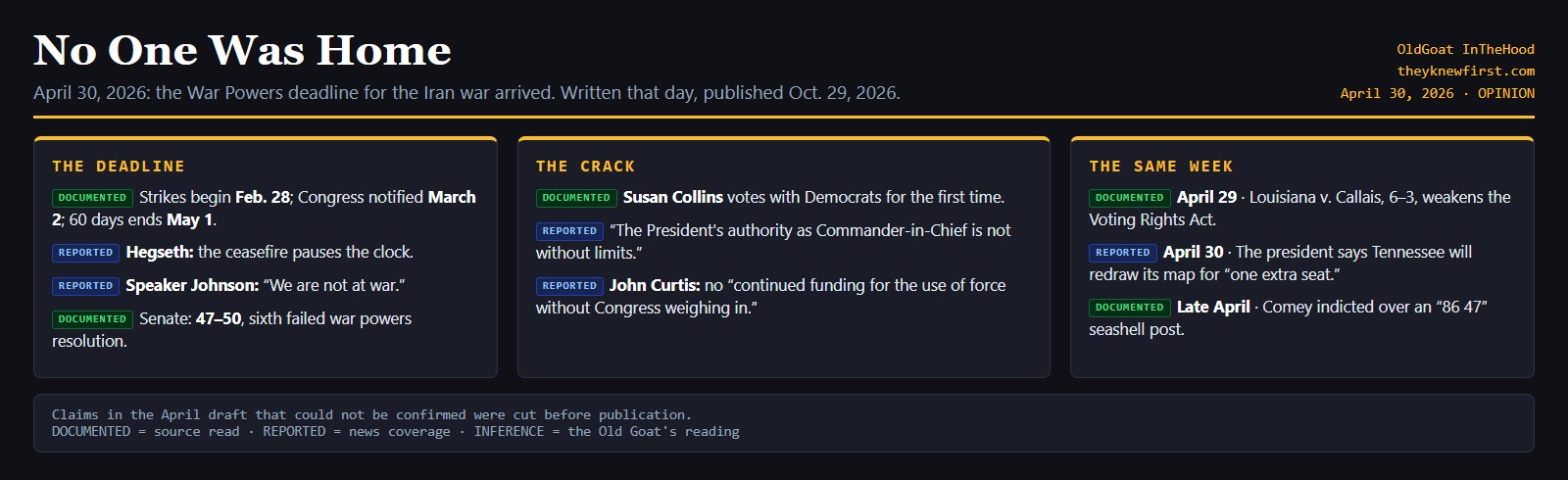
DOCUMENTED. The United States joined Israel in strikes on Iran on Feb. 28 and formally notified Congress on March 2. Under the War Powers Resolution of 1973, the president must withdraw forces within 60 days unless Congress authorizes the war, which puts the deadline at May 1. Fighting paused under a ceasefire on April 8. The naval blockade and the standoff over the Strait of Hormuz did not.
REPORTED. Defense Secretary Pete Hegseth told the Senate Armed Services Committee on April 30 that the ceasefire pauses the 60-day clock. He said he would defer to the White House counsel on the legal question. Sen. Tim Kaine answered: "I do not believe the statute would support that." Legal experts noted that the statute contains no pause. Defense News →
OPINION. The president controls the ceasefire. He can extend it or end it on his own. If a ceasefire stops the clock, any president can stop it whenever a deadline gets inconvenient, and restart the war when it passes. The ceasefire belongs to the president. Under this reading, so does the clock.
REPORTED. House Speaker Mike Johnson told NBC News that Congress need not act because "we are not at war." His words: "I don't think we have an active, kinetic military bombing, firing or anything like that. Right now, we are trying to broker a peace." The president has repeatedly called it a war. Mediaite →
DOCUMENTED. The Senate voted 47 to 50 against discharging S.J. Res. 184, a resolution to end U.S. hostilities against Iran absent authorization. It was the sixth failed war powers resolution on Iran. Bloomberg Government →
DOCUMENTED. Courts have not been a backstop. Members of Congress who sued over the Kosovo air war (Campbell v. Clinton, 2000) and over the Iraq invasion (Doe v. Bush, 2003) had their cases dismissed. No court has ever ordered a president to stop a war.
The Crack in the Wall
DOCUMENTED. Sen. Susan Collins of Maine voted with Sen. Rand Paul and most Democrats to discharge the resolution. It was the first time she had sided with Democrats on an Iran war powers vote. "The President's authority as Commander-in-Chief is not without limits," she said in a statement, and "further military action against Iran must have a clear mission, achievable goals, and a defined strategy." Collins chairs the Senate Appropriations Committee. Maine Public →
REPORTED. Sen. John Curtis of Utah did not join her, but he put out a statement ahead of the deadline: "I will not support continued funding for the use of force without Congress weighing in." KSL →
OPINION. Curtis said funding. That is the one lever Congress actually holds, and the chair of Appropriations just voted to use the other one. A protest vote from Collins would be one thing. A vote from the senator who writes the spending bills is a mechanism.
The Maps
DOCUMENTED. On April 29 the Supreme Court decided Louisiana v. Callais, 6 to 3, holding that Louisiana's 2024 map with a second majority-Black district is an unconstitutional racial gerrymander. Justice Samuel Alito wrote for the majority. Justice Elena Kagan, joined by Justices Sonia Sotomayor and Ketanji Brown Jackson, dissented: "I dissent because the Court betrays its duty to faithfully implement the great statute Congress wrote." Congress last reauthorized the Voting Rights Act in 2006; the Senate vote was 98 to 0. Constitution Center →
REPORTED. On April 30 the president posted that he had a "very good conversation" with Tennessee Gov. Bill Lee, who would work to correct an "unconstitutional flaw" in the state's congressional map. The president said the change should give Republicans "one extra seat." Tennessee Republicans hold eight of its nine House seats; the ninth, in Memphis, is the one in question. KATV →
OPINION. A day passed between the ruling and the post. Nobody is hiding the purpose.
The Pardon Power Has No Floor
DOCUMENTED. On his first day back in office the president pardoned or commuted the sentences of about 1,500 people charged over January 6. One of them was Andrew Paul Johnson. In February a Florida jury convicted him of molesting two children, and in March he was sentenced to life in prison. Police said he tried to bribe one victim with money he expected as restitution for January 6 defendants. NPR →
OPINION. The pardon power has always been sweeping. The only real check was the political cost of pardoning the indefensible. That cost is gone.
The Language of Threat
DOCUMENTED. A federal grand jury indicted former FBI Director James Comey in late April on charges of threatening the president, over a May 2025 Instagram photo of seashells on a North Carolina beach arranged to read "86 47." He first appeared in federal court in Virginia on April 29. The indictment says a reasonable recipient would read the image as a serious expression of intent to harm the president. Comey says he took the post down soon after putting it up. Democracy Docket → Ten Years to the Day →
OPINION. "86" is old kitchen slang for taking something off the menu. Anyone who has worked a line knows it. Defining a threat that far down, and then applying the definition to one side, is how a legal system gets pointed inward.
What This Is
OPINION. The constitutional crisis is not coming. The machinery built to prevent or resolve one has stopped working as designed. What remains is vocabulary: "war powers," "oversight," "judicial review," words attached to mechanisms that no longer bite. The war has no authorization. The legislature cannot compel. The courts defer.
OPINION. One Republican broke ranks. One. She faces reelection, and the law, as she said, has limits. The wall has a crack in it. Whether it holds or widens is the story of the next thirty days.
REPORTED, from October. In May a Kaine resolution advanced 50 to 47, with Collins, Lisa Murkowski, Rand Paul and Bill Cassidy voting yes, the first such measure to pass after seven failures.
OPINION. The crack widened, a little. The war went on anyway. After the Vote →